As data centres drive new demand for clean power, we looked at who gets to sell it, who benefits from the 200,000-baht tax deduction and the 50,000-baht scheme, and what is still unclear, grading every claim by its evidence.
Minimum size to sell green power directly1,000 kVA
Household buy-back2.20 baht
Low-use home margin over a loan≈ 210 baht/month
Main findings. The direct-sale rules are written for large plants; per unit, households and big solar farms are paid about the same, but contracts and scale differ. The tax deduction is worth more the higher your income. The 50,000-baht scheme’s terms are still unclear, and low-use homes have the thinnest margin.
Before you sign: a six-point checklist covers the rulebook, installer choice, the loan rate after the promotion, the buy-back term, your daytime use and the warranty.
Data centres: the real environmental and socio-economic costs, and the benefits
Our new guide pulls together the evidence on what data centres mean for electricity, emissions, water, air quality, e-waste, jobs, power bills and tax revenue, and what Thailand is doing about it.
CO₂ a year today≈ 180 Mt
Jobs per large site (US county)≈ 100–200
Thai execs naming water top concern68.8%
Environment. About 415 TWh of electricity in 2024, heading for 945 TWh by 2030; about 30% still from coal; up to 19 million litres of water a day at a large site; diesel backup generators and e-waste from fast chip upgrades.
Economy and society. Huge investment but few permanent jobs; in one US grid, data centres drove most of a ninefold jump in capacity prices that reached household bills; billions in tax breaks; and competition for water with farms and towns.
Thailand. A four-pillar screening framework, power and water mapping, closed-loop cooling for new projects, a 2,000 MW direct renewable-power pilot and proposed rules so large users bear the true cost of imported gas.
Why data centres use so much electricity and water
Data centres used about 415 TWh of electricity in 2024, about 1.5% of the world’s total, and the IEA expects this to more than double to about 945 TWh by 2030. AI is the main reason: its chips are far more power-hungry, and they run hot.
World use, 2024415 TWh
Forecast, 2030945 TWh
Large site, water per dayup to 19 million litres
Why so much electricity. AI runs on clusters of specialised chips (GPUs) that draw far more power than ordinary servers. The servers themselves use about 60% of a modern data centre’s electricity, according to the IEA. Cooling uses about 7% in the most efficient large sites and more than 30% in less efficient ones; storage and networking take most of the rest.
Why so much water. Much of the heat is removed by evaporative cooling, where water soaks up heat and evaporates. The Lincoln Institute reports that a large data centre can need up to 5 million US gallons a day (about 19 million litres), similar to a town of 50,000 people. There is also an indirect water cost: about half of the electricity US data centres use comes from fossil-fuel plants, which use water to make steam.
The trade-off. Operators can save water by cooling with more electricity (closed-loop and air systems), or save electricity by using more water. Because AI chips run so hot, many lean on water.
Why it matters in Thailand. Thailand has approved large data centre investments, and in a Federation of Thai Industries survey most executives named water supply as their top concern (see Thailand’s data centre boom). Solar panels make electricity without burning fuel or boiling water, which is one reason data centres are asking to buy renewable power directly.
What people on Facebook are saying about the 50,000-baht solar subsidy
We read about 175 public comments under four widely shared Facebook posts about the scheme (25–26 October). Clear worries outnumbered clear support by roughly six to one. Most worries were about money and trust, not about whether solar works.
Comments read≈ 175
Mainly concerns≈ 70%
Mainly supportive≈ 12%
What supporters say. It pays off for homes that use power in the daytime: retirees, home offices, shops and cafés with air-conditioning. One owner of a 5 kW system for three years says it saves about 2,000 baht a month when the bill is above about 5,000 baht. Others welcome help for people who could not afford solar in one go, say energy will only get dearer, and note that more rooftop solar means less imported gas.
What worries people. The biggest theme by far is debt: the 50,000 baht is seen as bait for a much bigger loan. Next come distrust of who supplies the equipment and who profits; the low 2.20-baht buy-back price against the 4-plus baht people pay; fears that installers will raise prices; long payback against inverter and battery life; no help at night without a battery; and safety and quality (fire, roof leaks, poor installers, panels without the Thai standard mark, e-waste). Some think the money should go to fuel prices, flood relief, farmers or the elderly instead, or that only people who already have money will benefit.
Common questions. How many years will power be bought back? Where do the panels come from, and what is the warranty? Can homes that already have solar use the subsidy to expand? Must people use an installer chosen by the government? What does a battery cost on top?
A note on the sample. Two of the four posts were framed critically, so this is not an opinion poll. Comments were read on 27 October 2026, before the official rules were published; we have not recorded any names. Our answers to the five biggest concerns are in the 50,000-baht subsidy guide.
Do you agree with the 50,000-baht household solar subsidy?
Agree
0%
Disagree
0%
Undecided
0%
One vote per device/network. Results show after you vote.
27 October 2026 · Data centres
Thailand’s data centre boom: what it means for the grid
Thailand’s Board of Investment approved 26 data centre projects worth almost 500 billion baht in 2025, and new applications passed 1 trillion baht by the first quarter of 2026. The planned pipeline is about 2.87 GW, mostly in the Eastern Economic Corridor.
Planned pipeline2.87 GW
Approved in 2025≈ ฿500 bn
World data centres, 2025≈ 485 TWh
Worldwide. The IEA estimates data centres used about 485 TWh in 2025, roughly 1.5% of the world’s electricity, and expects this to reach about 945 TWh (around 3%) by 2030. Centres built for AI used about a third of it.
In Thailand. Reports say the country has enough generating capacity (a reserve margin above 25%); the bottleneck is transmission. EGAT plans a 31-billion-baht transmission upgrade in the EEC. A pilot letting data centres buy renewable power directly is capped at 2,000 MW, with final rules still pending in mid-2026. Data centres are reported to pay about 5–6 baht per unit, against roughly 3–4 baht for homes. Water is the other worry: in a Federation of Thai Industries survey, 68.8% of executives named water supply as their top concern.
What it means for you: very large new users will compete with everyone else for grid upgrades over the next few years. The reports do not say this will raise household tariffs, so we are not predicting that. What you can control is how much of your daytime power you make yourself, on your own roof.
World energy use in 2025: electricity grew twice as fast, and solar led the growth
The IEA’s Global Energy Review 2026 says world energy demand grew 1.3% in 2025, below the average of the past decade, while electricity demand grew by nearly 3%. Solar was the largest single source of new supply.
Energy demand 2025+1.3%
Electricity demand≈ +3%
New solar generation600 TWh
Electricity is the fast-growing part. Electricity demand grew more than twice as fast as energy use overall. In the United States, data centres accounted for half of all electricity demand growth; worldwide, data centres and electric vehicles grew quickly from a small base.
Solar led the growth. Solar PV met over a quarter of the increase in total energy demand and added about 600 TWh of generation, about 70% of the growth in electricity generation. The world added a record 800 GW of renewable capacity, 75% of it solar. Low-emission sources covered nearly 60% of demand growth, and CO₂ emissions rose about 0.4%.
What it means for you: the panels on your roof are now the world’s main source of new electricity, not an experiment. For how installations are shifting between countries, see Solar installs fall in China, rise everywhere else.
Update 27 Oct 2026: the Cabinet review moved to Tuesday 27 October, with registration through PEA/MEA to open right after approval. PEA's example: a 5 kW system at about 140,000 baht leaves about 90,000 baht to pay after the subsidy. Read the full guide and latest updates →
24 October 2026 · Policy
฿50,000 toward solar for one million Thai homes: where the plan stands
A government plan to pay up to 50,000 baht toward a solar system for each of one million households has cleared a key screening board and is due before Cabinet on 26 October. Here is what has been reported so far, and what we suggest you do while the rules are finalised.
A summary of reporting by The Nation (20 October 2026 and 2 October 2026), The Thaiger (20 October 2026) and Pattaya Mail (20 September 2026). All credit for the reporting goes to these outlets. The notes for customers are ours.
Subsidy per householdup to ฿50,000
Households, phase one1 million
Sell-back, net billing฿2.20/kWh
Where it stands. The loan-spending screening board has approved the Interior Ministry’s 50-billion-baht proposal, paid from the energy-transition part of the government’s emergency borrowing. It is not final until Cabinet approves it, expected on 26 October.
Who and how much. One subsidy per household, up to 50,000 baht toward installation. Reports say applicants only need to be a registered electricity customer (a meter in their name); the final rules are still to be published.
What can be installed. The earlier proposal allows systems of up to 10 kW, on a roof, on open ground or floating on a pond. Only up to 5 kW can be sold back to the grid.
Selling surplus power. Surplus is bought at 2.20 baht per unit under net billing. The National Energy Policy Council raised the programme’s purchase target to 10,000 MW in September and extended the purchase period to 20 years (the earlier round was 10 years). Participating homes are to get a smart meter free of charge.
Loans for the rest. Government Savings Bank, Government Housing Bank and BAAC are expected to offer solar loans, reported at 2.5% a year over seven years without collateral, with sell-back income paying the loan down.
Who may install. The October proposal says installers must meet international standards, employ qualified engineers, be financially stable and be on the electricity authorities’ official vendor list.
When. Registration has been reported as opening 1 November or around mid-November; no date is confirmed. A second phase of 500,000 homes (25 billion baht) has been proposed but not approved.
What it means for you: a 50,000-baht grant covers roughly a third of a typical 5 kW home system, so this could be the best time in years to go solar. But do not sign or pay a deposit to anyone promising the subsidy until the rules and application channel are officially announced; schemes like this attract cowboy installers, and the government plans to allow only listed vendors. What you can do now: check that the electricity meter is in your name, keep a recent bill, and find out whether your supply is single-phase or three-phase. Officials estimate a 5 kW system could earn about 1,000 baht a month from surplus sales; that is a projection, and at 2.20 baht per unit, power you use yourself is still worth more than power you sell, so we size for daytime self-use first. Book a consultation and we will tell you as soon as the application rules are out.
Solar panels sold in Thailand must soon carry a mandatory safety standard (มอก.)
The Ministry of Industry is making the solar panel safety standard compulsory, with seven more standards in preparation for cables, batteries, inverters and protection gear. Here is what changes, and why it matters if you are buying a system.
The standard. TIS 61730 Part 2-2567, aligned with the international IEC 61730-2, covers the electrical, mechanical and fire safety of a panel. It has existed as a voluntary standard since June 2025; it now becomes compulsory, taking effect once published in the Royal Gazette, which the Industry Minister ordered for October.
What is tested. Heat resistance, safe electrical disconnection, performance at high temperature, protection against electrical leakage, resistance to fire spreading from heat or sparks, and mechanical strength.
Who must comply. Manufacturers, importers and sellers may only deal in certified panels. Making or importing non-compliant panels can bring up to 2 years in jail and a 2-million-baht fine; selling them, up to 6 months and 500,000 baht.
Next in line. Seven more standards are being prepared: DC cable, lithium batteries, fuses, inverters, DC circuit breakers, connectors and combiner boxes.
A possible short squeeze. SMM notes that TISI inspects each factory that supplies Thailand separately, and an IEC certificate does not convert automatically into a Thai licence. If the rule starts before enough factories are approved, certified panels could be short for a while. SMM saw no clear price premium for certified panels as of August.
What it means for you: this is good news for buyers. Burnt and melted systems found in this year’s consumer investigations (see our 17 October story) came largely from substandard parts and wiring. When you compare quotations, ask that every panel carries the มอก. mark and that the contract names the brand, model and standard of each item. The panels we propose are Tier-1 brands with IEC 61215 / 61730 certificates; we will confirm the มอก. licence on every quotation as the rule takes effect, and keep customers informed if supply tightens. See Our picks: Solar panels.
Thailand plans a recycling estate for old solar panels and EV batteries
The first big wave of Thai solar panels is nearing the end of its working life. The Ministry of Industry wants a dedicated, controlled estate to recycle them, together with EV batteries and e-waste, and much tougher fines for illegal dumping.
Why now. Panels installed about ten years ago are approaching the roughly 15-year service life the ministry assumes, so large volumes could reach the waste stream within one to two years. EV batteries are a growing second stream as Thailand’s EV fleet expands.
The plan. One controlled area for recycling plants and hazardous-waste treatment, with central wastewater treatment and 24-hour monitoring, so panels, batteries and e-waste stay out of ordinary rubbish. No location, size, budget or opening date has been given.
Second life first. Some used EV batteries can be reconditioned as energy storage before final recycling.
Tougher penalties. Some current fines stop at 200,000 baht. The ministry wants them raised to tens of millions of baht by amending the Factory Act and industrial-waste law, and to trace and seize the assets of illegal dumpers, working with the environment ministry, DSI and Customs.
What it means for you: a good panel lasts far longer than 15 years; quality panels carry 25–30-year power warranties, and most early failures we see come from installation, heat and dirt rather than the panel itself. So for most owners, recycling is a long way off. What helps now: buy panels that last, keep them clean and checked (see our cleaning and maintenance jobs), and when a panel or battery is replaced, make sure it goes to a licensed recycler, not the roadside. Ask us when you upgrade and we will handle the old equipment properly.
Panel prices in October: steady on paper, a little lower in practice
Chinese polysilicon makers are trying to agree a minimum price, but large stocks and weak demand keep panel prices under pressure. Here is the mid-October market picture, and what it means if you are planning a system.
Polysilicon. Stocks have kept growing to more than 560,000 tonnes. Producers met in Hangzhou to set a common minimum selling price, and some orders were signed above RMB 40/kg, but output still runs slightly ahead of demand.
Panels. Tier-1 TOPCon panels are quoted at RMB 0.70–0.72 per watt and second-tier below 0.68, but some actual deals closed at 0.65–0.69 as leading makers gave quiet discounts of 0.01–0.03 per watt. Buyers are waiting.
Cells and wafers. Weak, with high stock, except the large 210 mm formats used by utility-scale projects, whose prices could rise in the fourth quarter.
Outlook. EnergyTrend expects panel prices to slip a little further in the short term, with China’s efforts to curb price wars the main thing to watch.
Thailand. SMM put average landed (CIF) prices for TOPCon panels in Thailand at about US$0.11 per watt in August, slightly down from July.
What it means for you: panel prices are near the bottom and there is no sign of a jump, so there is no reason to rush, and no reason to wait for big falls either. In a typical home system the panels are now a smaller share of the cost than the inverter, battery, protection gear and installation, so it is worth spending on those. Two things could move Thai prices: the new mandatory panel standard (see above) and demand from the 50,000-baht subsidy. We check market prices every month and keep our price list in step; ask for it through a consultation.
Who controls the energy transition? Key points from TNI’s State of Power 2024
A 165-page report by the Transnational Institute looks at who owns, finances and profits from the move to clean energy, with case studies from four continents. Here are the main points in short, with a note on what they mean for solar in Thailand.
A summary of “Energy, Power and Transition: State of Power 2024”, Transnational Institute (TNI), edited by Nick Buxton, February 2024. All credit for the research goes to TNI and the report’s authors. The Thailand notes are ours.
An expansion, not yet a transition. Renewables are growing fast, but fossil fuels still supply about two-thirds of world energy. Oil and gas firms earned a record of about US$4 trillion in 2022, and most of that cash went to shareholders and debt repayment, with only a small share for clean energy.
Who uses energy. Industry takes almost half of the world’s electricity, while households use about a quarter. Sub-Saharan Africa is the only region where the number of people without electricity has grown since 2000, to about 589 million.
Private renewables, public risk. In Africa, “de-risking” deals use public guarantees and fixed power-purchase contracts so that private investors carry little risk, while states and communities carry the rest. South Africa’s US$8.5 billion transition package is mostly loans, with very little in grants.
Big solar and wind can leave locals behind. Case studies from India (the 2 GW Pavagada solar park), Germany (Brandenburg) and South Australia show large projects bringing cheap power but few local jobs, and land owners gaining far more than landless villagers.
Citizen ownership works. In Germany, citizens, cooperatives and farmers held about 40% of renewable capacity by 2019, thanks to feed-in tariffs. That share is now falling as banks and big utilities take over.
Public options are coming back. New York passed a law in 2023 for its public power authority to build renewables, aiming for 70% renewable power by 2030. Germany saw 284 energy re-municipalisations between 2005 and 2017.
Small fixes, big gaps. In Lebanon, homes switched to solar panels and batteries during blackouts, but only those who could afford them. The authors also warn of future waste from old panels and batteries without a plan to handle it.
Waste-to-energy is a weak answer. Burning waste supplies under 3% of Europe’s energy and emits about 1.2 tonnes of CO₂ per tonne of waste. Long contracts that guarantee a minimum amount of waste can block recycling. The report notes Thailand plans 79 such plants.
Community energy in practice. Across Latin America, over 100 community projects use solar panels, small hydro and biogas run by local people, with women often leading.
The report’s main call. Put the transition under more public and community control: fair land deals, revenue-sharing, local jobs and training, and grants rather than debt for poorer countries.
What it means in Thailand: the report’s strongest point for us is that energy owned by the people who use it keeps the benefits local. Rooftop solar on a home, resort, school or factory is exactly that: the owner keeps the savings, and the money stays in the community rather than flowing to a distant investor. It also echoes what we see on site: good design and local, qualified installers matter as much as the panels. The report is written from a strongly public-ownership viewpoint and some of its proposals are political; we share it for the facts and case studies, so readers can judge for themselves. See our Technical page for practical guides.
Silicon-rich battery cells pass 1,000 cycles: what it means for solar storage
Germany’s Fraunhofer ISE has built lighter, more energy-dense lithium cells with a silicon-rich anode. Here is the news in short, with a note on what it means for home and resort batteries in Thailand.
The cells. 25 Ah pouch cells whose anode is a silicon-carbon and graphite blend, with silicon-carbon making up about half of the active material, paired with a nickel-rich NMC cathode. They were made on a semi-automatic line using commercially available electrode foils.
The result. More than 83% of capacity kept after over 1,000 full cycles at 1C, with an energy density of 280 Wh/kg in a research format. Fraunhofer expects about 330 Wh/kg once the format is optimised for industry.
The project. Part of the German StrOboBatt project led by PCC Thorion with Fraunhofer ISE and Glatt Ingenieurtechnik, with LG Chem Europe among the partners and €2.6 million of public funding. The main target is stationary storage of solar and wind power, with electric vehicles and aerospace also named.
The caveats. The 83% figure only holds when the cells are kept under high mechanical pressure; at lower pressure the capacity fell much faster, and no figure was published. Usable capacity during normal cycling also drifted below the slow-test capacity as the cells aged. This is research work with no launch date.
What it means in Thailand: the big win of silicon anodes is weight, which matters for cars and aircraft, not for a battery bolted to a wall. For home, homestay and resort storage, lithium iron phosphate (LiFePO4) remains far ahead on the things that count: the batteries we install are rated for more than 6,000 cycles, against about 1,000 cycles to 83% here, and LiFePO4 copes better with heat in a Thai plant room than nickel-rich NMC. Our battery advice does not change; see Our picks: Battery. We will keep watching silicon-anode cells for EV charging and portable storage.
A record 93% bifacial solar panel: what it means for Thai homes and carports
Tongwei says its new TNC 3.0 “Bifimax” panel turns light on its back side into power almost as well as on its front. Here is the news in short, with a note on where it matters in Thailand.
The record. TÜV Rheinland verified a bifaciality of about 93%: the back of the panel produces about 93% of what the front produces from the same light. Most bifacial panels today reach 80–88%.
The panel. A 770 W TOPCon module with 24.8% efficiency, losing about 0.26% of its power for each degree of heat.
How. Tongwei credits a new rear-side texture and an improved “zebra-crossing” contact design; the cell itself reaches 94.3% bifaciality.
The caveats. This is a certified record, not yet a product on sale: the article does not say when it will be mass-produced, and in 2025 Tongwei itself called 90% bifaciality in mass production “a major challenge”. The extra-income figures for large solar farms are company estimates.
What it means in Thailand: extra output from the back of a panel only comes when light can reach it. On a normal roof the back is in shade, so a bifacial panel adds very little. The gain is real on raised carports, A-frames and ground mounts, especially over light-coloured ground, gravel or a white roof. For most home and shop roofs our advice does not change: single-sided back-contact panels give the most power per square metre. For open sites, high-bifaciality TOPCon panels are becoming even more attractive. See our 650–670 W panel comparison to choose the right panel for your site.
The honest downsides of solar, and how they look in Thailand
A UK solar group-buying scheme has listed seven real drawbacks of going solar. Here they are in short, with a note on how each one plays out for homes and businesses in Thailand.
A summary of “The Honest Disadvantages of Solar Energy” by Mathew Williams, Switch Together (iChoosr Ltd), 13 January 2026. All credit for the original article goes to Switch Together. The Thailand notes are ours.
No sun, no power. Panels make nothing at night and less on cloudy days, so solar alone cannot run a home around the clock; a battery fills the gap. In Thailand: sunshine is strong all year and most homes and businesses use the most power in the daytime, so far more of the output is used straight away. A battery is worth it mainly for evening use or backup during outages.
It needs space. A useful system needs a fair area of roof or ground, and a battery needs room too. In Thailand: roofs are usually big enough; the bigger questions are roof strength, shade from trees or buildings, and which way the roof faces.
The upfront cost. Solar is a medium- to long-term investment rather than an instant saving, although prices have fallen fast. In Thailand: payback is often a few years for daytime users. Try our savings calculator to see the price for your system size.
Upkeep. Rain helps, but the article suggests a professional clean every 1 to 2 years and a fuller check every 4 to 5 years. In Thailand: dust, smoke-haze season and bird droppings cut output faster, so a yearly clean and system check pays for itself. We run project based cleaning and maintenance jobs at every system we look after.
Battery waste. Batteries thrown away carelessly can pollute soil and water. They can be recycled, and they last many years. In Thailand: ask who will take the battery back at the end of its life before you buy.
Looks. Some people dislike how panels look, so placement matters. In Thailand: modern all-black panels and careful layout help a lot.
The technology keeps improving. Early buyers can feel left behind, but today’s panels already cut bills and emissions well. In Thailand: waiting for “better” panels means paying full electricity bills in the meantime.
What it means for you: none of these is a reason to avoid solar, but each one is a question to ask before you sign: how much of the power will you use yourself, is the roof strong and unshaded, who cleans and checks the system, and who takes care of the battery at the end of its life? Book a consultation and we will go through them for your home.
Thailand: consumer board investigates faulty solar installations
Thailand’s Office of the Consumer Protection Board (OCPB) has opened an investigation into substandard home solar installations, after homeowners reported melting and burning equipment and electricity bills that did not go down.
A summary of reporting by pv magazine, “Thailand opens investigation into faulty solar installations” by Patrick Jowett, 19 May 2026, with details from Thai press (Thairath, Thai PBS, InfoQuest). All credit for the reporting goes to pv magazine and the Thai news outlets listed below.
Households being helped17
Reported losses500k+ ฿
Areas affected3
What happened. The OCPB is assisting 17 homeowners in Khon Kaen, Saraburi and the Tha Phra area of Bangkok after their solar systems showed signs of melting and burning. Thai press put the losses at more than 500,000 baht.
Bills did not drop. Homeowners told a meeting chaired by Minister Supamas Isarabhakdi that their bills stayed the same after installation, and that the installer would not take responsibility.
What went wrong. Early checks found sub-standard equipment, aluminium cable used in place of copper, and a three-phase supply changed to single-phase. The result was voltage drops, outages, melted parts and a real fire risk. One case has gone from the police to the public prosecutor.
Possible criminal charges. The board says cases like this may count as selling deceptive goods, which can carry jail time and fines. Product labelling breaches alone can cost a seller up to 6 months in jail or a 100,000 baht fine, and a manufacturer or importer up to 1 year or 200,000 baht.
New rules on the way. The minister asked the board to make solar installation a “regulated contract business”, so every contract must state the equipment standards and specifications. She also wants labelling rules for panels, inverters and batteries.
Who is involved. Officials met the Thai Industrial Standards Institute (TISI), the Metropolitan Electricity Authority (MEA) and the Provincial Electricity Authority (PEA) to stop this happening again. Consumers with similar problems can complain to the OCPB by hotline (1166) or online.
What it means for you: before you sign, ask any installer, including us, four questions. Is all cabling copper? Will your supply stay as it is (three-phase stays three-phase)? Does the contract name the brand, model and standard (มอก./IEC) of every item? And who is responsible if something goes wrong? We are happy to put all of this in writing. Book a consultation and we will go through it for your home.
New Zealand: solar complaints double, and the call for better protection grows
New Zealand’s energy complaints service, Utilities Disputes, says complaints about solar more than doubled in a year. Most are not about faulty panels. They are about savings that never arrived and long contracts that customers cannot get out of.
Complaints doubled. Utilities Disputes received 440 solar complaints in the year to 31 March 2026, up 105% on the previous year.
Promises, not hardware. The main complaints are systems that did not deliver the savings customers were promised, and agreements that are hard or expensive to exit.
One company stands out. SolarZero leased solar systems on 20-year contracts and went into liquidation in late 2024. It held about 0.5% of the market but was involved in 20.8% of the deadlocked complaints Utilities Disputes accepted. One customer said his import rate rose from 8c to 26c per kWh.
A gap in protection. Utilities Disputes can often only take a solar complaint if the seller belongs to its scheme, and not every solar company does. That is the heart of the call for stronger consumer protection: one place every solar customer can go.
What is being done. Utilities Disputes is preparing consumer guidance, with a focus on long-term solar subscriptions. The industry body SEANZ published a solar quality-assurance report in August 2026, looking at consumer codes used in Australia and the UK. Political plans are moving toward households owning their systems outright rather than leasing them.
What it means for you: before you sign for solar anywhere, check three things. Are the savings figures realistic and explained? Will you own the system outright? And who is responsible if something goes wrong? Ask any installer these questions, including us. Book a consultation and we will answer them for your home before you decide.
The Union of Concerned Scientists (UCS), a US science non-profit, has updated its review of the environmental impacts of solar power. Its answer: solar is not impact-free, but its footprint is small next to coal and gas, and most of it can be reduced by choosing the right site and building panels that last.
A summary of “Environmental Impacts of Solar Power”, Union of Concerned Scientists, first published 5 March 2013 and last updated 4 March 2026. All credit for the research goes to the Union of Concerned Scientists.
Lower CO₂ than gas, life cycle−91%
Lower CO₂ than coal, life cycle−96%
Typical panel life30+ yrs
Land.. Rooftop solar uses no extra land. Large US solar farms use about 2.9–4.2 acres (1.2–1.7 ha) per megawatt. Building on degraded land, old mines, or along roads and power lines reduces the impact, and so does sharing land: solar over crops (agrivoltaics) or floating on reservoirs and ponds (floating solar), which also cuts evaporation.
Wildlife.. Clearing land can fragment habitats and release carbon stored in the soil. Using land that is already disturbed, putting panels on roofs and over car parks, and planting native, pollinator-friendly plants under the panels all help.
Water.. Solar panels use no water to make electricity; only manufacturing uses some. Washing panels can raise output, though in the US it is often not worth the cost.
Materials.. Silicon panels are about 87% glass and aluminium; thin-film CdTe panels are over 90%. Lead (in silicon panels) and cadmium (in CdTe panels) are each under 0.1%. An International Energy Agency study found low health risk even in a worst-case unlined landfill, and a 2023 study found no arsenic, gallium, germanium, hexavalent chromium or PFAS. Factories do handle strong acids, so worker safety matters.
Waste.. US panel waste to 2050 is estimated at 54–160 million tonnes. Coal ash would be 300–800 times larger. Recycling is not yet common because it often costs more than the materials are worth, so the best lever is longer-lasting panels: 10% longer life cuts life-cycle waste by 53%.
Climate.. Making electricity from sunlight gives off no greenhouse gases. Counting manufacturing, transport, installation and disposal, solar PV emits about 91% less CO₂-equivalent than gas power and 96% less than coal (NREL, 2021).
Concentrating solar (CSP).. Mirror-based thermal plants use more land (5–10 acres per MW), need cooling water unless dry-cooled, and their tower designs can harm birds and insects. They are a very small share of solar.
What it means for you: a rooftop system is the low-impact end of solar: no extra land, no water, and power that stays clean for decades. We fit Tier-1 panels built to last 25–30 years.
Rooftop solar in Thailand: what helps, what holds it back
CASE for Southeast Asia, a regional energy-transition programme, has published a review of home rooftop solar in Thailand. Its conclusion: the technology is proven. What slows it down now is cost, roof space, how exported power is paid for, and what happens to panels at the end of their life.
The support that exists. Under the People's Solar scheme, households can sell surplus solar power to PEA or MEA at THB 2.20 per kWh for 10 years. Households can also deduct up to THB 200,000 of the cost of a home rooftop system from taxable income until December 2028. Because it is a deduction and not a refund, how much it saves depends on the owner's tax bracket.
Upfront cost. The smallest common system is about 3 kW. It makes roughly 300–400 kWh a month and pays for itself in about six to seven years. A battery for evening use makes the system more independent, but it adds cost and lengthens the payback.
Roofs and condos. The roof must be strong enough and face the sun. People in condominiums and apartments usually cannot install at all. Letting buyers take solar power from elsewhere through the grid (third-party access) would help them. Thailand's 2,000 MW Direct PPA pilot does this, but it is only for large users such as data centres, not homes.
Net billing versus net metering. Thailand pays for exported power in money (net billing), at a lower rate than the price you pay for grid power. Under net metering, each exported unit would cancel one unit you buy, which would shorten payback. The review notes the other side as well: grid stability, and network costs moving onto households without solar.
Panels at end of life. Panels last about 25–30 years. Thailand could have about 9,900–57,200 tonnes of used panels by 2030, and it has no full system yet for collecting and recycling them. The review suggests making producers responsible and setting up reuse and recycling.
Update: the sell-back scheme has reopened. The review notes that the old 90 MW quota closed in June 2024. Since then, the Energy Regulatory Commission has opened a new round of 500 MW at the same THB 2.20 per kWh for 10 years, with applications from 1 July 2026, first come, first served. Up to 5 kW per meter can be sold (a larger system is fine for your own use), batteries are allowed, and the system must be supplying the grid by 2027. In Chiang Rai and other PEA areas, apply through PEA's PPIM system.
What it means for you: at THB 2.20, power you use yourself is worth much more than power you sell. So we still size systems for daytime self-use first and treat sell-back as a bonus for the surplus. If you want to join the new round, we can size the system to fit the 5 kW limit and prepare the PEA application with you. Book a consultation and we will work out the payback for your home.
When the load fell, the solar fell too: zero export in practice
A 20 kWp solar plant we look after in Chiang Rai lost two buildings from its supply on 1 October. Over the next 15 days its electricity use fell 42%, and its solar production fell 21%, even though the weather was better than in late September. The reason is a setting many owners choose without knowing what it costs: zero export.
Consumption, 15 days−42%
Solar production, 15 days−21%
October solar left unused~35%
Consumption
2,162 kWh1,258 kWh
Solar production
612 kWh482 kWh
16–30 Sep1–15 Oct
Why the solar fell. The plant has no battery, and export to the grid is switched off in the inverter. So the inverter can only produce what the building is using at that moment. On busy days, when the load reached 180–320 kWh, the panels delivered 50–58 kWh, close to what the season allows. On quiet days the load was only about 46 kWh and the panels gave about 31 kWh. On Sundays, with the site closed, they gave almost nothing. About 265 kWh of free solar went unused in the first half of October alone.
Zero export still leaked. Even with export off, about 14% of the solar still reached the grid. Most of the load sat on one of the three phases, while the inverter feeds all three evenly, so the lightly used phases sent power out while the busy phase drew power in. Without a sell-back agreement, that energy earns nothing.
What it means for you: if your system is set to zero export, check what happens on your quiet days. Balancing the load across the three phases, running flexible loads such as air conditioning or water pumps at midday, a PEA sell-back agreement or a small battery can all turn unused sunshine into savings. We can read your monitoring data and tell you which fits your site.
Solar installs fall in China, rise everywhere else
BloombergNEF now expects the world to install 584 GW of solar in 2026, about 11% less than last year. The whole drop comes from China, where installations are forecast to fall 29%. Outside China, the market is still growing, by about 15%.
China 2026−29%
Rest of world 2026+15%
World 2026584 GW
China
383 GW271 GW
Rest of world
272 GW313 GW
World
655 GW584 GW
20252026 forecast
China slows down. China installed 383 GW in 2025; BNEF now expects about 271 GW this year. In the first half of 2026 it added roughly 72 GW, against 212 GW in the same months of 2025. BNEF puts this down to a saturated market and a new five-year plan that shifts attention from adding capacity to energy storage, not to politics or prices.
The rest of the world keeps growing. Outside China, installations are forecast to rise from 272 GW to 313 GW. Most of that growth comes from homes and businesses rather than large solar farms. BNEF named India, the Philippines, Nigeria and Malaysia among the growth markets, and says rooftop and commercial solar is now the largest area of renewable energy investment worldwide.
What it means for you: the growth is happening where Solar ESS works, on homes, resorts and businesses, and in our own region, with the Philippines and Malaysia named. China’s slowdown does not mean solar is losing ground; it means the world’s biggest market is pausing to build storage. The article does not say how this will affect panel prices, so we are watching prices month by month and will keep our price list in step.
Grounding a solar system: why one earth point is not enough
New research from Indonesia shows that adding a second grounding point to a solar array can cut the voltage spike from a direct lightning strike by roughly half. We read the study alongside other recent research, the international lightning standards and the Thai wiring code. Here is what it adds up to.
Voltage cut with a 2nd point43–55%
Soil 30 → 3,000 ΩmHigher spikes
Best earth pointNearest the strike
What the study found. Researchers at Institut Teknologi Sepuluh Nopember and Universitas Hasanuddin simulated a 50 kA lightning strike on a section of ten panels. They compared earthing through the panel frames with earthing through the mounting structure, moved the earth point around, and tried one versus two earth connections. Where the earth point sits, and how many there are, mattered more than whether the frames or the structure carried the current.
Frames earthed: voltage reduction with a second earth point
47.5–54.8%
Mounting structure earthed: voltage reduction with a second earth point
43.2–50.7%
Earthing through the mounting structure gave slightly lower peaks because its path has lower resistance. An earth point close to where lightning strikes gave the lowest voltage, because the current has a shorter way to go. In poor, dry or rocky soil (3,000 Ωm against 30 Ωm), every voltage rose. The study is a computer simulation and does not cover damage to cables or inverters, so it shows the direction, not exact numbers for a real site.
What other research and the standards add.
Ground-mounted arrays need a mesh, not just a rod. A Graz University of Technology study of an 84 m × 84 m solar farm found that strikes at the corners give the highest step voltages, that a tighter bonding mesh works better, and that meeting the common 10 Ω earth-resistance figure on its own does not guarantee safe step voltages in high-resistivity soil.
Bond first, then earth. All panel frames, rails and metal parts should be joined into one continuous system and connected to the building’s main earth terminal with a low-resistance link. The DC wires themselves are not earthed; the inverter watches their insulation instead.
Lightning rods change the design. If the building has a lightning protection system, the array should either sit inside its protected zone at the required separation distance, or, if that distance cannot be kept, be bonded to it with conductors that can carry lightning current and protected by Type 1 surge arresters on the DC side. Industry engineers warn that simply clamping the array to the lightning tape can send strike current down the DC cables to the inverter.
Surge protection on both sides. Fit SPDs on the DC and AC sides as close to the inverter as possible, and add another set when the cable between the arrester and the equipment runs longer than about 10 m. Long DC runs are better in metal tray or armoured cable than in plastic conduit.
Thai rules. The EIT wiring standard (2556) calls for earth rods at least 16 mm in diameter and 2.40 m long, driven at least 2.40 m into the ground, sets 5 Ω as the limit where a metal building structure is earthed, and sizes the earthing conductor by the main cable (at least 10 mm² copper for main conductors up to 35 mm²).
The approach we recommend
Bond every frame and rail into one continuous system with proper earthing clamps, and connect it to the building’s main earth.
On larger roofs and ground mounts, use more than one earth connection, placed at the ends and corners of the array, with short, straight paths to the ground.
Measure earth resistance at handover. In dry or rocky soil, add rods or a ring electrode until the reading is acceptable.
Fit SPDs on both the DC and AC sides at the inverter, and add another set near the array when the cable run is long.
Run DC plus and minus cables together to avoid loops, and use metal tray or conduit for long runs.
Where there is a lightning rod system, design for the separation distance or full lightning bonding. Never just tie the array to the lightning tape.
Inspect once a year: loose clamps, corrosion and SPD status indicators.
What it means for you: good earthing is cheap compared with a burnt inverter. If your system has a single earth wire, or you are not sure how it was earthed, ask us to check it. This is work for a qualified electrician, and the relevant standards and the equipment makers’ instructions have the final word. Our SPD choices are on the Our picks page.
Solis S6 50 kW hybrid: the original vs the new “21A” version
Solis has refreshed its three-phase high-voltage hybrid inverter. The S6-EH3P50K-H keeps the same 50 kW rating and the same box, but the new 21A version takes more current from each solar string and each battery port, works with larger battery modules and can be paralleled into bigger systems. Here are the two side by side.
Max. current per string2021 A
Max. current per MPPT4042 A
Total battery current140160 A*
Battery module size280314 Ah
Parallel system size500600 kW
Weight7376 kg
Specification
50K (flyer V3.8)
50K (21A)
PV input
Recommended PV array
100 kW
100 kW
Max. / rated / start-up voltage
1000 / 600 / 180 V
1000 / 600 / 180 V
MPPT voltage range
150–850 V
150–850 V
MPPTs / strings
4 / 8
4 / 8
Max. input current
4 × 40 A
4 × 42 A
Max. current per string
20 A
21 A
Short-circuit current
4 × 60 A
4 × 60 A
Battery
Battery voltage
150–800 V
150–800 V
Battery ports
2
2
Max. charge / discharge current
70 A × 2
80 A × 2*
Battery modules supported
100–280 Ah
100–314 Ah
Grid, generator and backup
Rated output
50 kW / 50 kVA
50 kW / 50 kVA
Rated current (220/380 · 230/400 V)
76.0 / 72.2 A
76.0 / 72.2 A
Max. AC pass-through
152 / 144.4 A
152 / 144.4 A
Generator input
50 kW
50 kW
Backup rated power
50 kW
50 kW
Backup overload
160% for 2 s
160% for 2 s · 150% for 10 s
Backup switch time
< 10 ms
< 10 ms
Phase imbalance
—
100% on the backup port
Parallel system
500 kW
600 kW
Build and approvals
Size (W × H × D)
530 × 880 × 290 mm
530 × 880 × 290 mm
Weight
73 kg
76 kg
Protection · temperature · altitude
IP66 · −25 to +60 °C · 4000 m
IP66 · −25 to +60 °C · 4000 m
Cooling
Intelligent fan
Intelligent redundant fans
Insulation & residual-current monitoring
—
Yes (listed)
Surge protection
DC II / AC II
DC II / AC II
AFCI 2.0
Optional
Optional (off by default, enabled in app)
Display
7″ LCD · Bluetooth · app
7″ LCD · Bluetooth · app
Communication
CAN, RS485, Ethernet; opt. Wi-Fi, cellular, LAN
CAN, RS485 (115200); opt. Wi-Fi, cellular, LAN
Thai grid approval
PEA, MEA
PEA, MEA
New functions
—
Peak shaving · reactive power compensation · anti-reverse flow
▲ improved · ▼ slightly lower · = unchanged
What it means for you: the 21A version is not a bigger inverter, it is a more capable one. The extra string current gives headroom for today’s large high-current panels, faster battery charging stores midday surplus sooner, and 314 Ah support suits current battery racks. Grid, generator and backup ratings are unchanged, so it drops into the same designs. Both versions carry PEA and MEA approval.
Figures are the maker’s own. Original: Solis S6-EH3P(29.9-50)K Global Flyer V3.8. 21A version: Solis user manual S6-EH3P(50-60)K-H(21A) V1.0 and the Solis product page. *Solis lists 80–84 A per battery port across the 21A range; we show the lower figure until confirmed against the V4.0 flyer. Efficiency figures for the 50K (21A) are not yet published clearly and are left out.
Mova launches a home battery that also manages EV charging
Chinese storage maker Mova has launched the LumeGret S5000, a small all-in-one unit that combines a solar inverter, an expandable LiFePO4 battery and smart charging for an electric car, all run from one phone app.
What is inside. The inverter has four MPPT inputs taking up to 4.8 kW of solar in total, but at low voltage (13–48 V, 60 V maximum), so it is built for a handful of panels rather than a full rooftop string. Batteries come in 3 kWh and 5 kWh modules and can be stacked to 15 kWh or 25 kWh. Mova quotes at least 10,000 cycles, a 10-year warranty, IP65 protection, self-heating for cold weather and a built-in aerosol fire extinguisher. Output to the house is 800 W by default and can be set up to 3 kW; off-grid it supplies up to 3 kW. The unit weighs 14.8 kg.
The EV part. An optional 7 kW charger, the LumeGret E7000, is controlled from the same Movahome app. Owners can set charging times, power levels and priorities. The system can start charging the car automatically when spare solar passes 500 W, and in markets with changing electricity prices it can pause when power is expensive and charge when it is cheap.
What it means for you: the 800 W default output and low-voltage solar input point to the European plug-in "balcony" market, not a typical Thai home with a full rooftop system. The idea is still worth watching: one box that decides when to fill the battery and when to charge the car with spare solar. Mova has not announced prices or availability, the figures above are the maker's own, and Thai PEA grid-connection rules still apply to anything connected to the grid.
Two boards, built and checked before they reach site
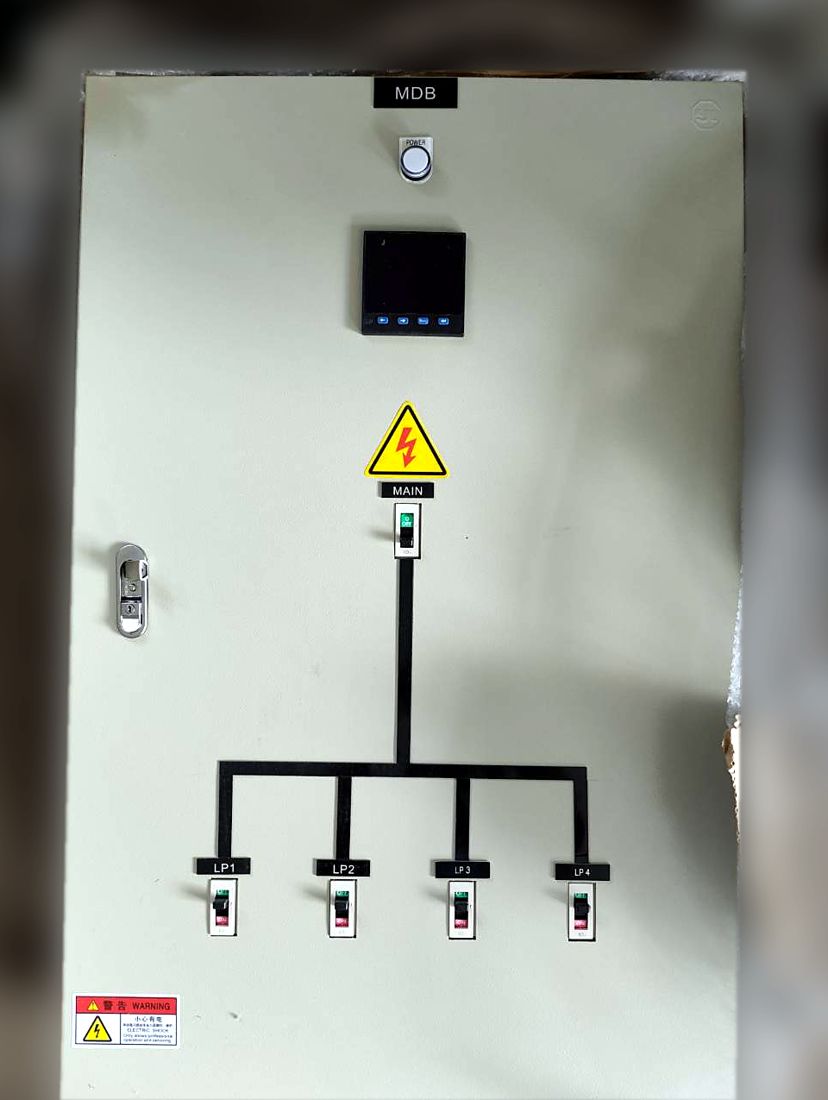
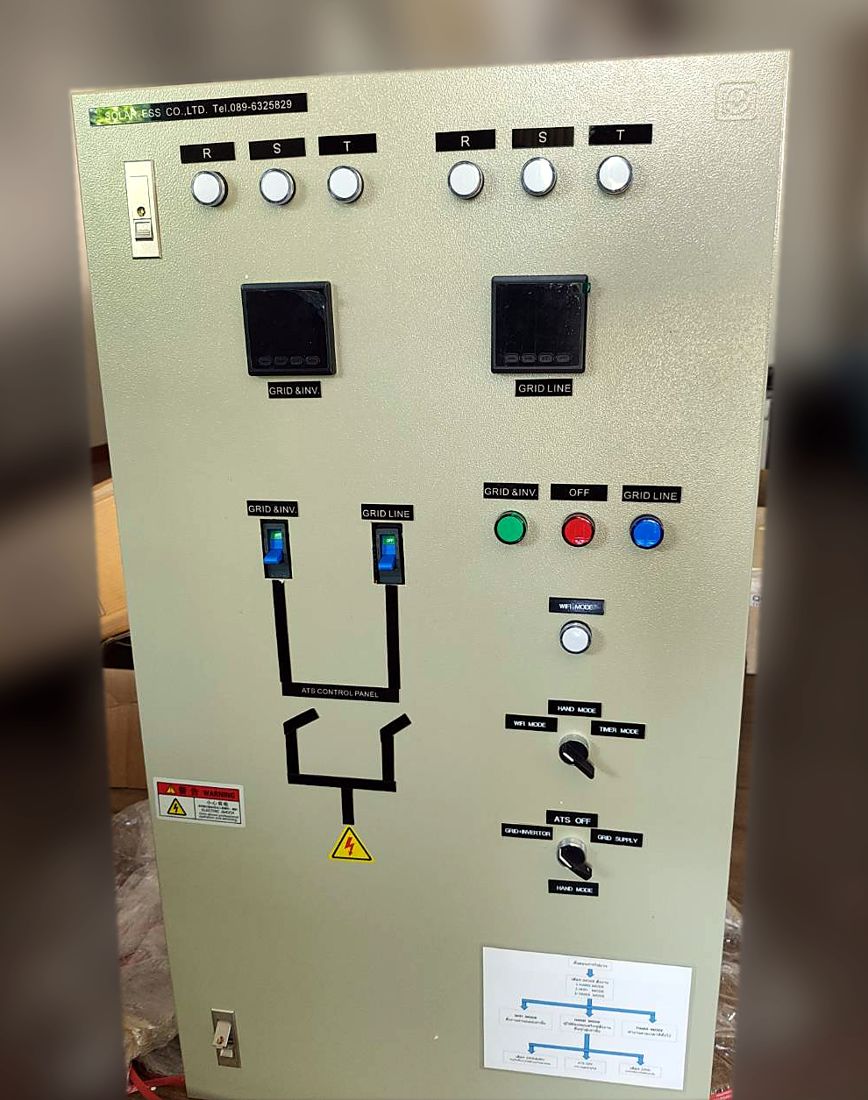
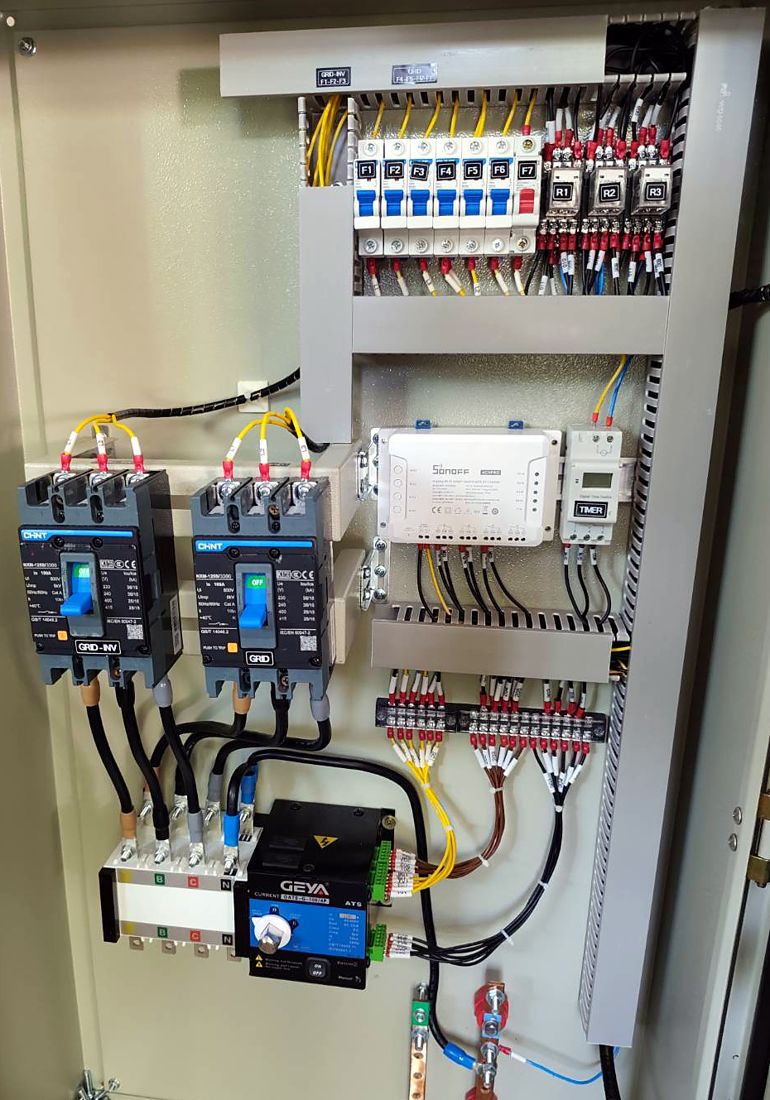
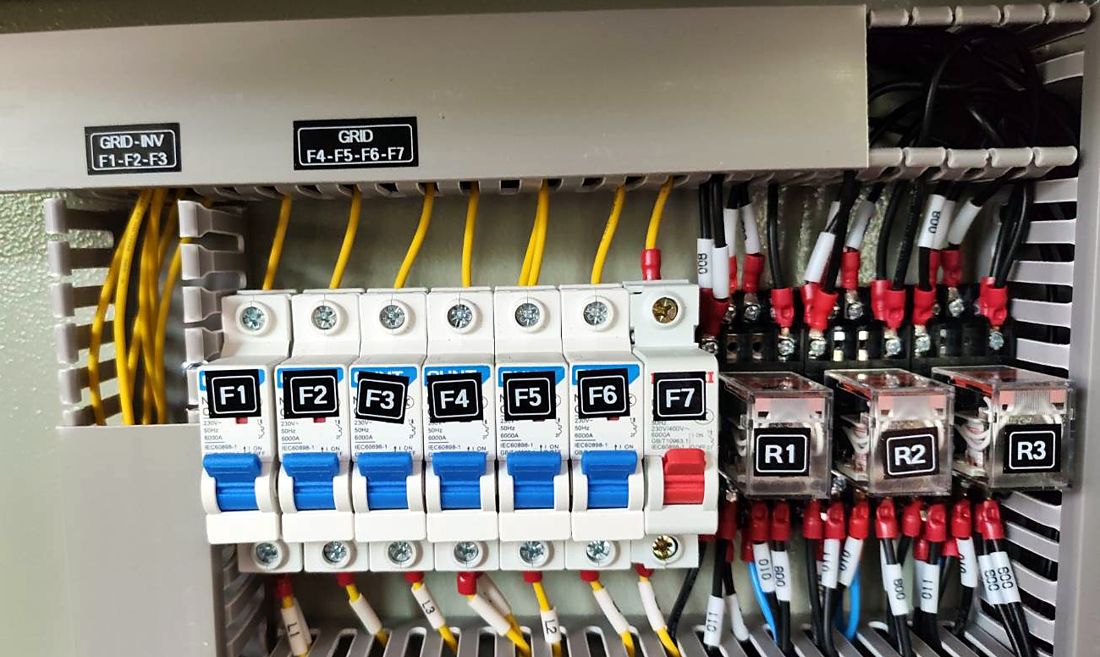
This week the Solar ESS team finished two boards for a solar job in Chiang Rai: a main board that splits the supply into four circuits, and a control panel that switches the building between solar and the grid. Both are wired, labelled and tested in our workshop, so on site they only need to be mounted and connected.
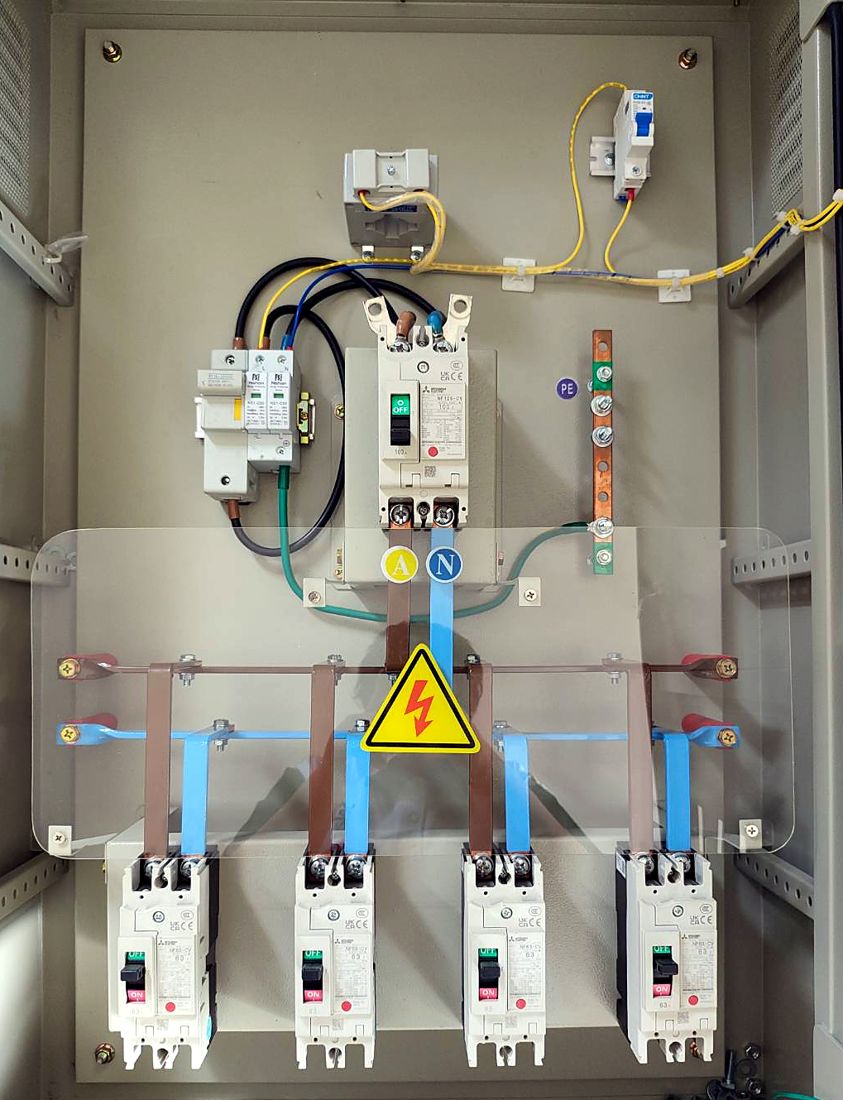
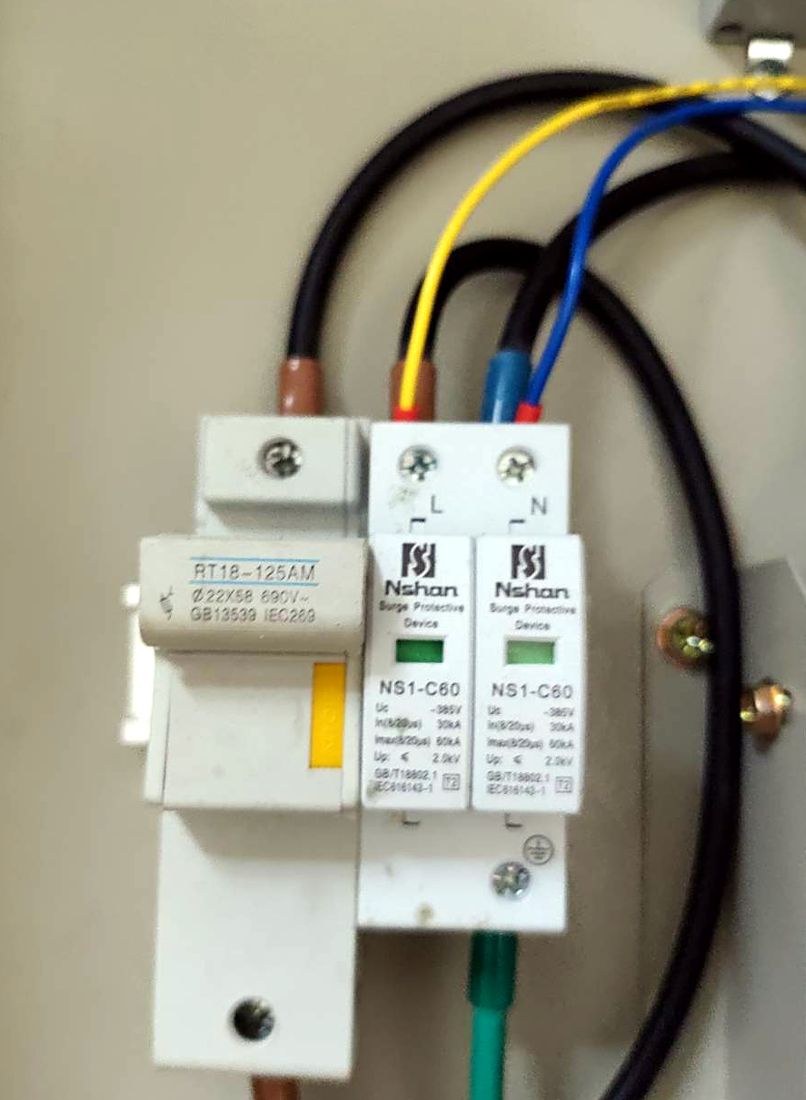
The main board (MDB). Power comes in through one main breaker and is shared out to four outgoing breakers, LP1 to LP4, one for each load circuit. A surge protection device sits right after the main breaker to take lightning and switching spikes to earth, and a digital meter on the door shows voltage and current at a glance. A clear cover keeps fingers away from the live busbars, and the single-line diagram printed on the door matches what is inside.
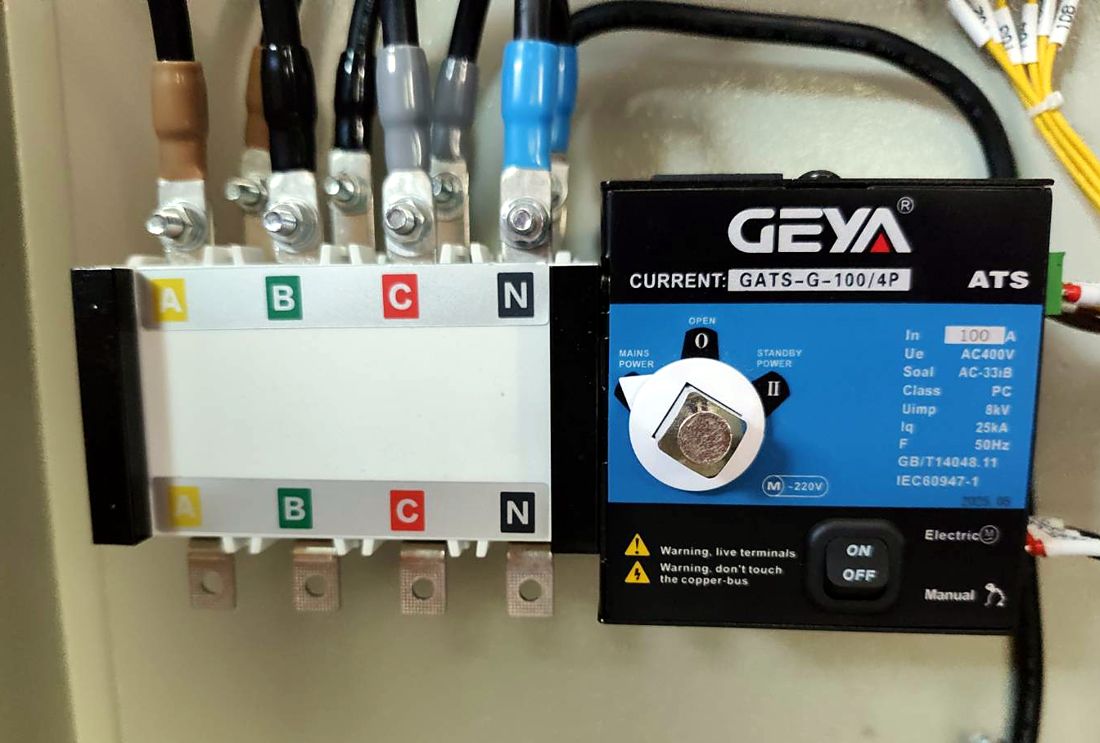
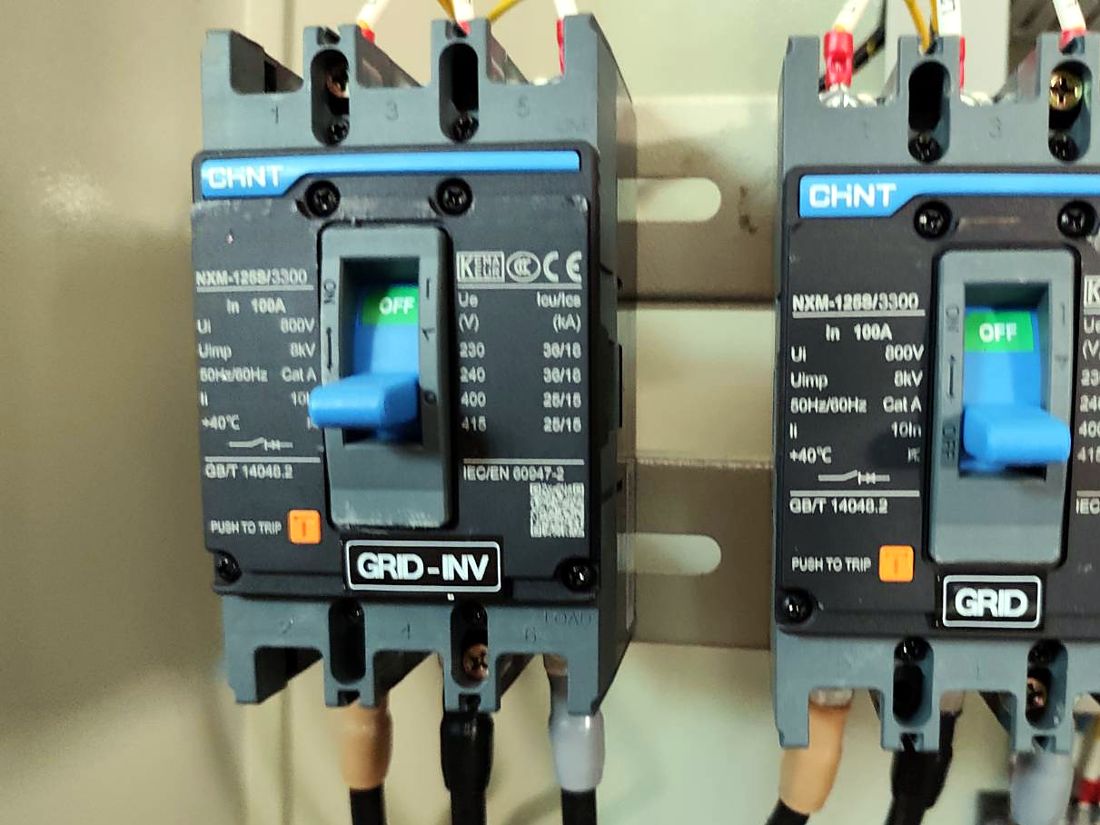
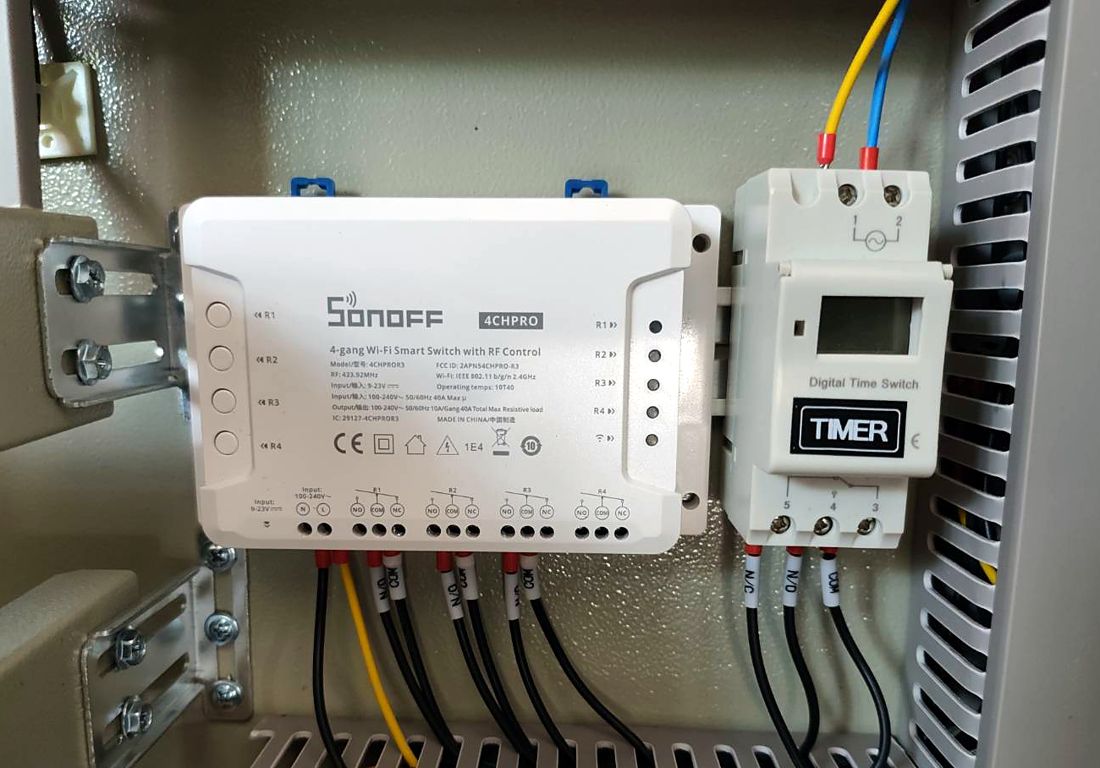
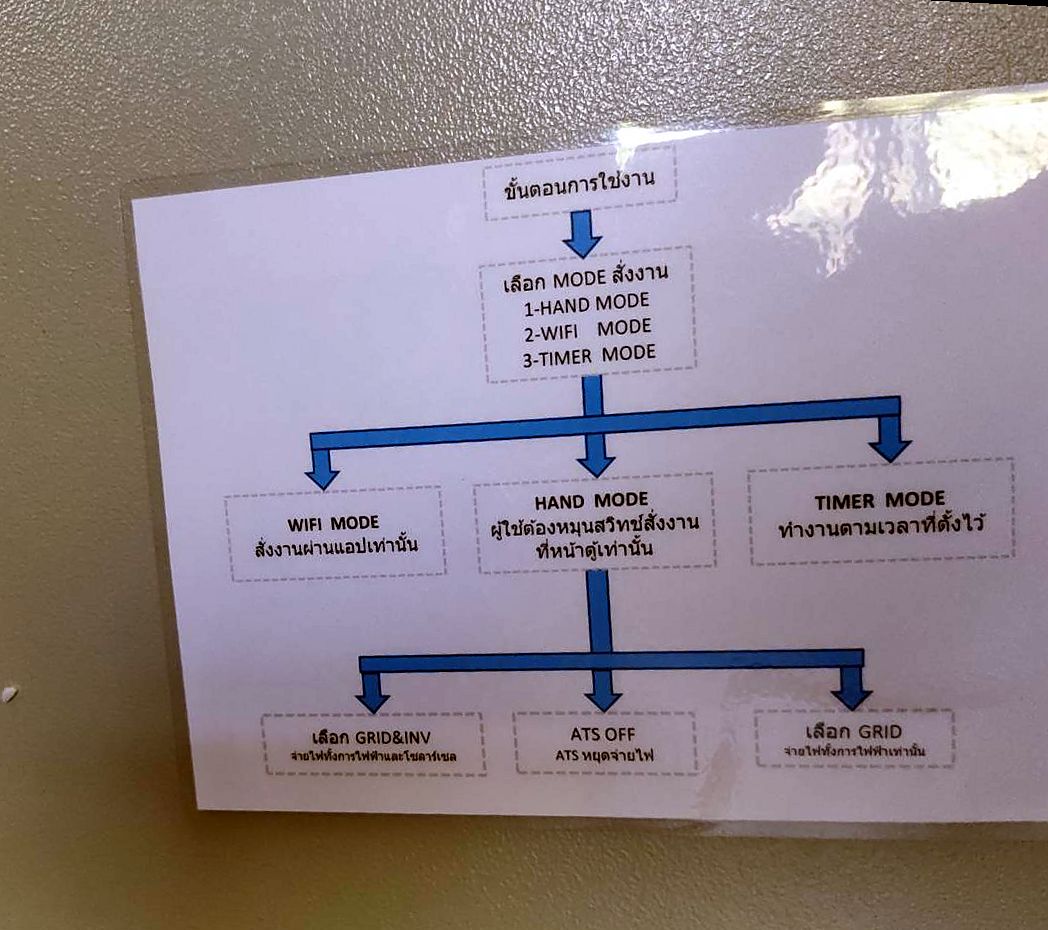
The solar / grid control panel. This panel takes two supplies, solar-and-inverter and PEA grid, each through its own 100 A breaker, and an automatic transfer switch (ATS) decides which one feeds the building. The panel can run in three modes:
Hand mode: someone turns the selector on the door to choose the source.
Wi-Fi mode: the owner switches the source from a phone app.
Timer mode: the panel changes source at times set in advance, for example solar by day and grid at night.
Indicator lamps show all three phases of each supply, a meter for each side shows what it is delivering, and every control wire runs through its own fuse and relay, numbered so a technician can trace it later. A printed chart inside the door explains the modes in Thai for the owner.
What it means for you: a well-built board is the part of a solar system you rarely see, but it decides how safely the power is shared out and how easily it can be serviced. If you are adding solar to a building with more than one supply, ask us how an ATS panel could fit. Our breaker, SPD and ATS choices are on the Our picks page.
Main board, door closedMain board inside: main breaker to LP1–LP4Surge protection after the main breakerSolar / grid control panelControl panel insideAutomatic transfer switch (ATS)One breaker per supply: solar-inverter and gridWi-Fi control and timerControl fuses F1–F7 and relays R1–R3Mode chart for the owner (Thai)
14 October 2026 · Safety
The breaker that worked fine until the solar went in
An RCBO is the small breaker that protects a circuit against earth leakage, overload and short circuit in one unit. Most people never think about which way power flows through it. Once a home has solar, a battery or a generator, that question decides whether the breaker will actually trip.
A familiar story. A house has been wired for years with ordinary RCBOs. Power always came one way: from the grid, through the main switch, through each RCBO and out to the lights and sockets. Then a hybrid inverter and battery are added, and the backup circuit is fed from the inverter. Everything switches on and seems to work. But on that circuit, power can now come in from the side the breaker was never designed to be fed from.
Why it matters. A unidirectional RCBO is built for power flowing one way only, from its Line (In) terminals to its Load (Out) terminals. Fed backwards from the load side, it may not trip on a fault, can be damaged, and can leave its internal electronics live while someone thinks the circuit is safe. A bidirectional RCBO is tested and certified by its maker to break a fault and detect leakage whichever way the power is flowing.
How to tell which one you have. Look at the case and the small wiring diagram on the front. Terminals marked Line / Load or In / Out, or an arrow, mean unidirectional. A bidirectional RCBO has no fixed supply side, or its datasheet says plainly that it is suitable for power flowing in both directions. If the datasheet does not say bidirectional, treat it as unidirectional.
How it should be wired.
On a unidirectional RCBO, the incoming supply goes only to the Line / In terminals and the circuit goes to Load / Out.
Never connect an inverter output, battery feed or generator to the Load side of a unidirectional RCBO.
On any circuit that solar, a battery, a generator or a V2G charger can feed, fit an RCBO the maker certifies as bidirectional, and wire it to the maker's diagram.
Where the neutral must be switched as well, use a double-pole device.
What it means for you: if you have added solar or a battery to an existing board, ask your installer which RCBOs sit on the circuits the inverter can feed, and whether they are bidirectional. This is work for a qualified electrician, and the device datasheet has the final word. Our breaker choices are on the Our picks page.
Risen launches a glare-free solar panel for sites near airports and homes
Chinese panel maker Risen Energy has released the Hyper-ion RSM132-8-710-730BHDG, a 710–730 W heterojunction (HJT) panel with 22.9–23.5% efficiency and a matte anti-glare front glass. It is made for places where reflected sunlight could dazzle people, such as near airports and homes.
Risen says TÜV Rheinland tested the panel and gave it a Class AAA anti-glare rating, with as little as 0.85% of sunlight reflected straight back. It is double-glass and bifacial, loses only 0.24% of power per °C of heat, and comes with a 15-year product warranty and a 30-year power warranty (at least 90.3% output after 30 years).
What it means for you: glare matters most where panels face neighbours' windows or sit near an airport. At 2.4 m long and 37.5 kg, this panel suits commercial roofs and ground mounts better than homes. Risen has not announced prices or availability in Thailand, and the figures above are the maker's own.
AIKO earns a certificate for treating workers fairly
AIKO, a solar panel maker, announced on 5 October 2026 that it has received SA8000 certification for its operations worldwide. SA8000 is an international standard for how a company treats its people: human rights, fair labour, safe workplaces and ethical business.
This is AIKO's own announcement and does not name the auditor or the factories covered. The certificate is about how the panels are made, not how well they perform. AIKO is one of the panel brands Solar ESS installs.