Technical

How we build,
written down.

Short notes from our engineering work: what a part does, how to choose it, and how to install it properly. Free to read, download and share.

Topics

Monthly Report 9 notes

Every month Solar ESS reviews the solar systems it has installed and monitors on DeyeCloud, SolisCloud, Huawei FusionSolar, SolarEdge, Enphase, ATMOCE and other platforms: production, battery use and the settings that cost owners energy, followed by the changes made and their results. Site names are removed.

October 2026 · DeyeCloud

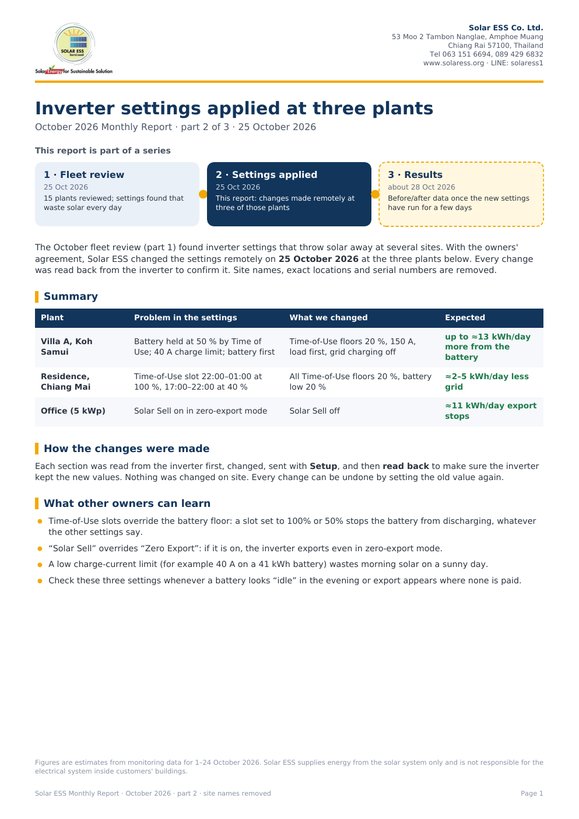
First page of part 2 of the October 2026 Monthly Report: inverter settings applied at three plants

Monthly report · part 2 of 3 · 4 pages · PDF · English

October 2026 · DeyeCloud · Settings applied (part 2 of 3): three plants – battery limits, Time of Use and Solar Sell

The October fleet review (part 1) found settings that waste solar every day. On 25 October Solar ESS changed them remotely at three of those plants – a holiday villa, a family home and an office – and read every value back from the inverter to confirm it. Results will follow in part 3 once the new settings have run for a few days. All site names removed.

  • Before and after values for every setting changed
  • Holiday villa: battery held at 50% by Time of Use, 40 A charge limit, battery first
  • Family home: a 22:00–01:00 Time-of-Use slot at 100% kept the battery idle every evening
  • Office: “Solar Sell” on in zero-export mode sent about 11 kWh a day to the grid for nothing
  • Three settings every owner should check
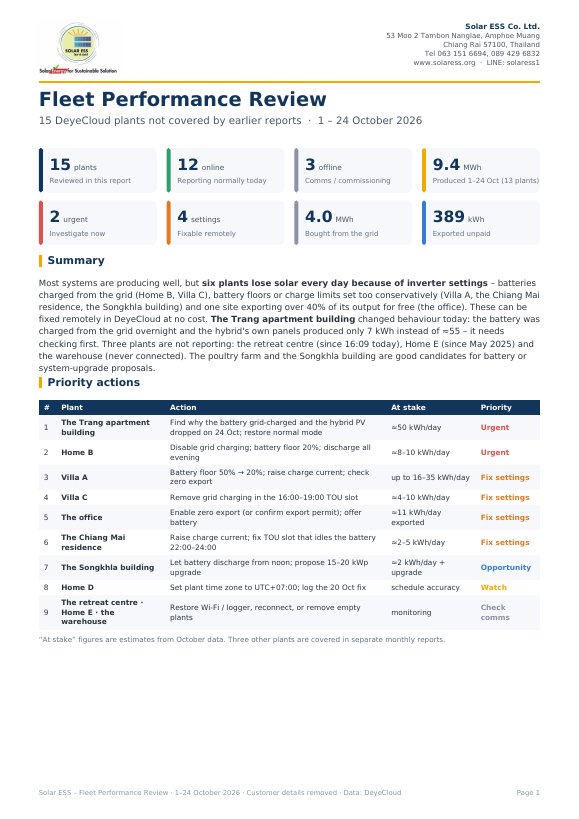
First page of the October 2026 fleet performance review

Monthly report · 7 pages · PDF · English

October 2026 · DeyeCloud · Fleet review (part 1 of 3): 15 plants – six losing solar every day to inverter settings

A review of 15 monitored systems – homes, villas, an apartment building, an office, a farm and commercial buildings – for 1–24 October. Most produce well, but batteries charged from the grid, battery floors and charge limits set too cautiously, and unpaid export cost several sites solar energy every day. All site names removed.

  • Fleet overview: production per kWp and share of use covered by solar for every system
  • Nine priority actions with the energy at stake
  • Plant-by-plant charts, findings and recommended fixes
  • Common inverter-setting mistakes: grid charging, high battery floors, low charge current, Time-of-Use slots
  • Systems that stopped reporting, and what to check

Part 1 of 3 · next: part 2 – settings applied at three plants

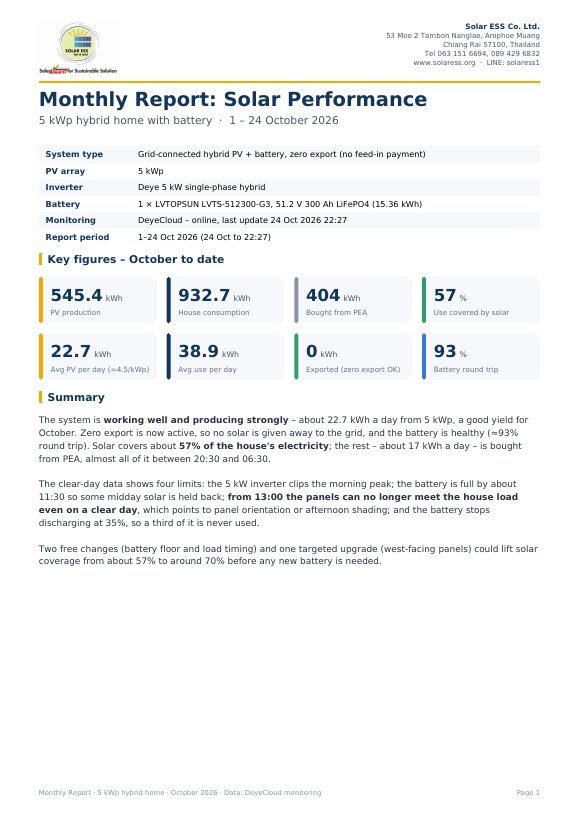
First page of the October 2026 monthly report for a 5 kWp hybrid home

Monthly report · 4 pages · PDF · English

October 2026 · DeyeCloud · Plant report: a 5 kWp home at 57% solar – a free setting change and west-facing panels to go further

Monthly report for a 5 kWp hybrid solar home with a 15.36 kWh battery and zero export. Solar covers 57% of the house's use; the rest is bought at night after the battery stops at 35%, and from 13:00 the panels can't meet the load even on a clear day.

  • Daily use split into solar and grid for 1–24 October
  • When grid power is bought, hour by hour
  • A clear day annotated: inverter clipping, midday curtailment, the afternoon gap and the battery floor
  • Six ideas with estimated gains, from free settings to west-facing panels and a second battery
  • Recommended inverter settings and a solar coverage roadmap
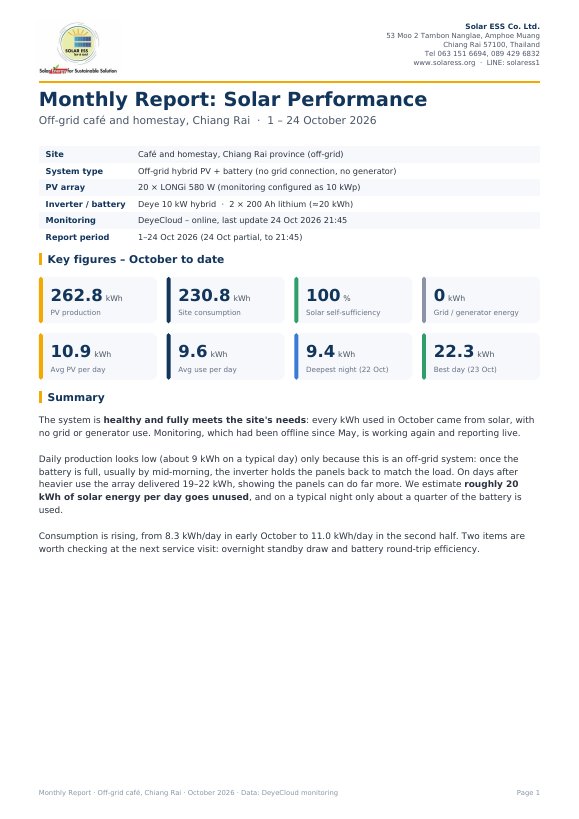
First page of the October 2026 monthly report for an off-grid café in Chiang Rai

Monthly report · 4 pages · PDF · English

October 2026 · DeyeCloud · Plant report: an off-grid café running 100% on solar – with storage as the next step

Monthly report for an off-grid café and homestay in Chiang Rai with 11.6 kWp of panels, a 10 kW hybrid inverter and about 20 kWh of batteries. Every kWh used in October came from solar, but the battery is full by mid-morning and around 20 kWh of sun a day goes unused.

  • Daily production, consumption and battery use for 1–24 October
  • Where the solar energy went, and a typical day hour by hour
  • Nine findings, including overnight standby draw and battery efficiency
  • Recommended off-grid inverter settings, value by value
  • Next steps: load shifting, a service check and planning for growth
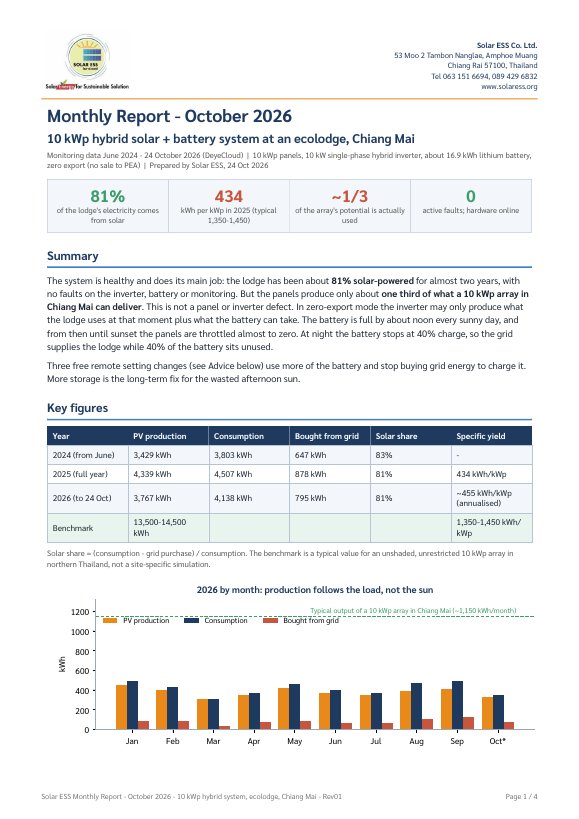
First page of the October 2026 monthly report

Monthly report · 4 pages · PDF · English

October 2026 · DeyeCloud · Plant report: a 10 kWp hybrid system using only a third of its sun – and the settings that fix part of it

Monthly report for a 10 kWp hybrid solar + battery system at an ecolodge in Chiang Mai. The lodge runs about 81% on solar, but in zero-export mode the battery is full by noon and the panels are throttled for the rest of the day, while at night the battery stops at 40%.

  • Yearly and monthly production, consumption and grid purchase (434 kWh per kWp in 2025)
  • A sunny day hour by hour: where the solar is lost
  • Four findings from the 5-minute data
  • Advice on adjusting the inverter: battery floor, time-of-use grid charging and charge current, value by value
  • Next steps: load shifting and adding storage

October 2026 · SolisCloud

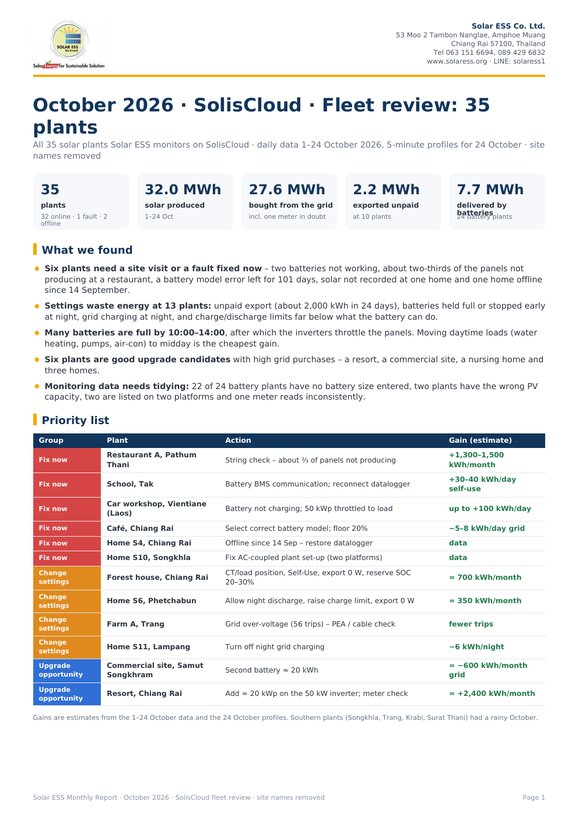
First page of the October 2026 SolisCloud fleet review

Monthly report · 21 pages · PDF · English

October 2026 · SolisCloud · Fleet review: 35 plants – one idle battery, unpaid export and batteries full by midday

All 35 plants Solar ESS monitors on SolisCloud, reviewed from daily data for 1–24 October and 5-minute profiles for 24 October – the same checks as the DeyeCloud fleet review. Five plants need a fault fixed, fourteen need settings changed, and many batteries are full by midday so the panels are throttled. All site names removed.

  • Yield per kWp for every plant, grouped into fix now, change settings, upgrade and healthy
  • Priority list with the energy at stake
  • Plant-by-plant charts: a full day of solar, load, grid and battery, plus daily totals
  • Fleet-wide issues: unpaid export, low battery current limits, grid charging, wrong plant set-up, grid voltage trips
  • Recommended standard settings for hybrid systems without a sell-back contract

Also: a one-page report for each plant

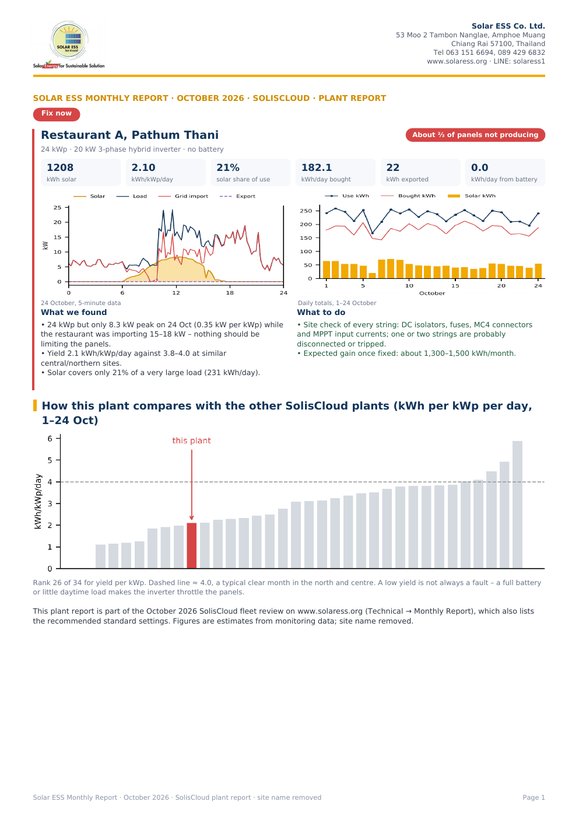
Example one-page SolisCloud plant report, October 2026

Monthly report · 35 plant reports · 1 page each · PDF · English and Thai

October 2026 · SolisCloud · Plant reports: a one-page report for each of the 35 plants

The plant-by-plant pages of the SolisCloud fleet review, as separate one-page reports: monthly figures, 24 October profile, daily totals for 1–24 October, what we found, what to do, and how the plant ranks against the rest of the fleet. All site names removed; each plant keeps its label in future months.

Next in this series: Huawei FusionSolar fleet review

October 2026 · Huawei FusionSolar

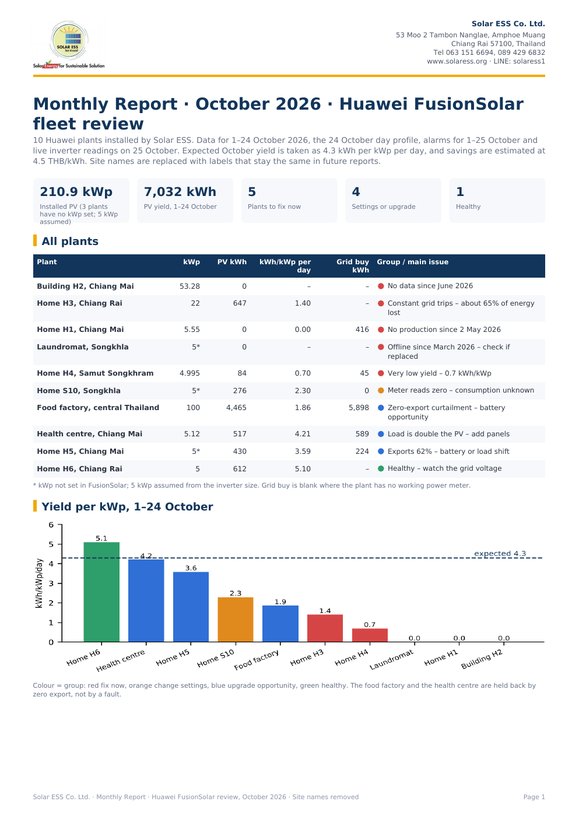
First page of the October 2026 Huawei FusionSolar fleet review

Monthly report · 12 pages · PDF · English

October 2026 · Huawei FusionSolar · Fleet review: 10 plants – two stopped, grid trips and zero-export curtailment

All 10 Huawei plants Solar ESS monitors on FusionSolar, reviewed from daily data for 1–24 October, the 24 October profile, the month's alarms and live inverter readings – the same checks as the SolisCloud fleet review. Five plants need fixing now: one has produced nothing since May, one has sent no data since June, and one loses about two-thirds of its energy to grid voltage and frequency trips. The two largest plants are held back by zero export. All site names removed.

  • Yield per kWp for every plant, grouped into fix now, change settings, upgrade and healthy
  • Priority list with the energy at stake each month
  • Plant-by-plant charts: daily output, a full day of solar, load and grid, and 2025 against 2026
  • Fleet-wide issues: high grid voltage, missing plant capacity, sites also on SolisCloud

Also: a one-page report for each plant

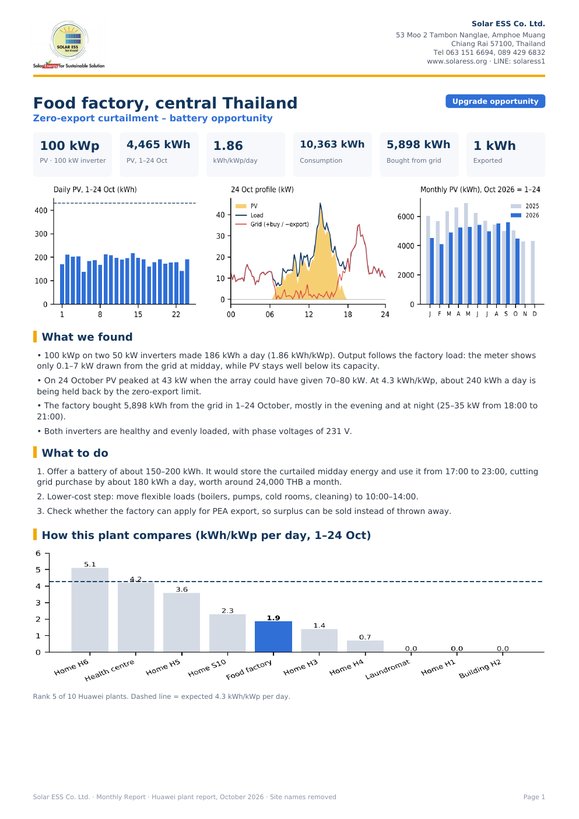
Example one-page Huawei plant report, October 2026

Monthly report · 10 plant reports · 1 page each · PDF · English and Thai

October 2026 · Huawei FusionSolar · Plant reports: a one-page report for each of the 10 plants

The plant-by-plant pages of the FusionSolar fleet review, as separate one-page reports: monthly figures, 24 October profile, daily totals, what we found, what to do, and how the plant ranks against the other Huawei plants. All site names removed; each plant keeps its label in future months.

System design & energy 5 notes

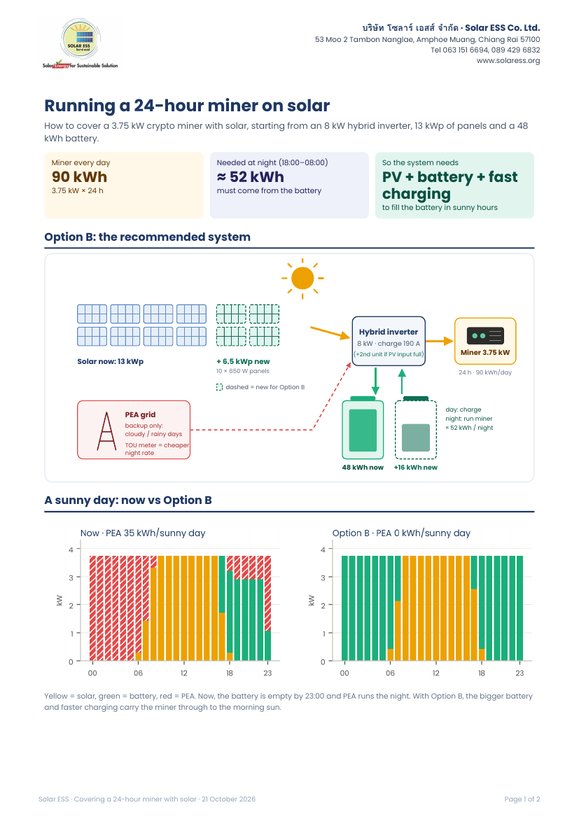
First page of how to run a 24-hour crypto miner on solar

Design guide · 2 pages · PDF · English

Running a 24-hour miner on solar: what it takes

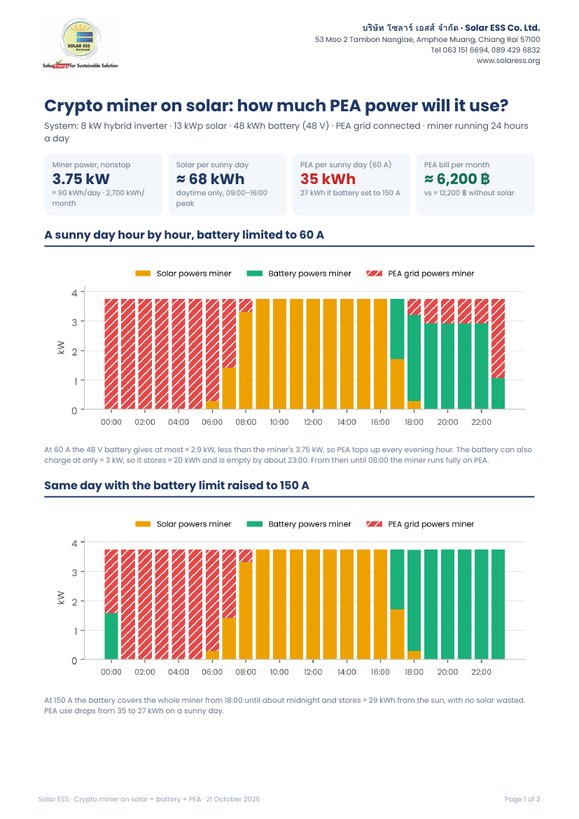
A 3.75 kW miner needs 90 kWh a day, about 52 kWh of it at night. Starting from an 8 kW hybrid inverter, 13 kWp of panels and a 48 kWh battery, we compare four upgrade options and show the one that runs the miner fully on solar on sunny days.

  • System drawing: what to add (about 6.5 kWp of panels and a 16 kWh battery)
  • Sunny-day charts before and after the upgrade
  • Monthly PEA use and cost for each option, with a TOU meter
  • Three steps, and why 100% solar all year does not pay back
First page of the crypto miner on solar, battery and PEA analysis

Energy analysis · 2 pages · PDF · English

A crypto miner on solar: how much PEA power will it still use?

A 3.75 kW miner runs 24 hours a day, about 90 kWh. We modelled it on an 8 kW hybrid inverter with 13 kWp of solar and a 48 kWh battery, and compared a 60 A battery limit with 150 A. Solar roughly halves the PEA bill, but the night still runs on PEA.

  • Hour-by-hour charts: what solar, battery and PEA supply on a sunny day
  • PEA use per day for sunny, cloudy and no-solar days
  • Monthly PEA energy and cost with and without solar
  • Battery current setting, grid-side connection and 25 A wiring for a 24-hour load
First page of the ice machine solar and TOU summary

Customer summary · 1 page · PDF · English, Thai

A 24-hour ice machine: solar by day, TOU by night

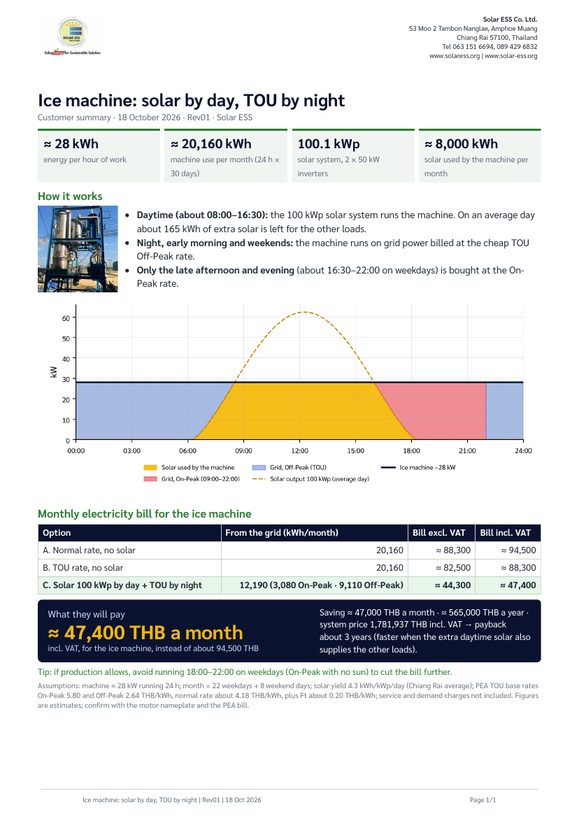
How a 100 kWp solar system and the PEA time-of-use tariff cut the electricity bill of a tube-ice machine that runs around the clock, from about 94,500 to about 47,400 THB a month.

  • About 28 kWh per hour of work, about 20,160 kWh a month
  • A 24-hour chart of solar, On-Peak and Off-Peak supply
  • Monthly bill: normal rate, TOU only, and solar + TOU
  • Savings, payback and a tip on the 18:00–22:00 On-Peak hours
Single-line diagram of the 62.4 kWp solar system for a tube ice plant

Design · 5 pages · PDF · English, Thai

Solar for a tube ice plant: 62.4 kWp on-grid, zero export

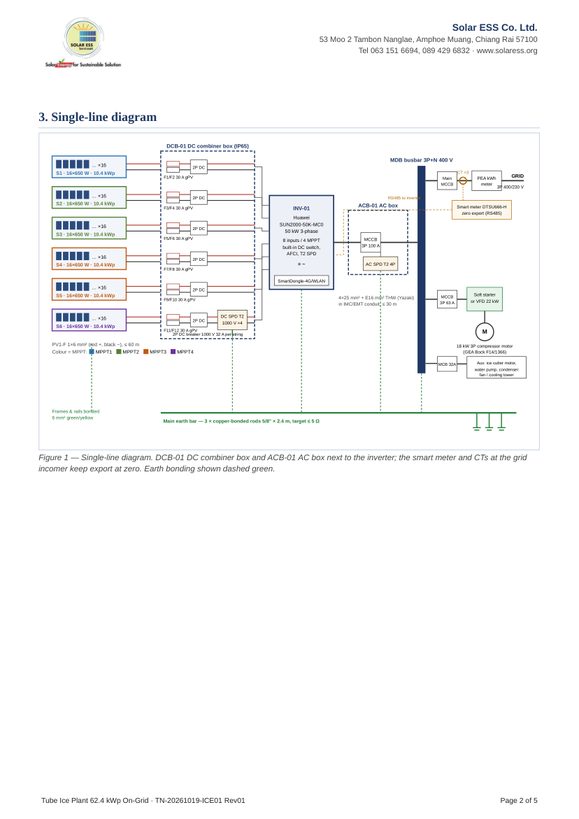
A daytime solar design for a tube ice machine with an 18 kW 3-phase compressor motor: 96 × 650 W panels on a 50 kW Huawei inverter, covering the machine from about 09:00 to 15:30 on a clear day, with the grid for motor start and cloudy spells.

  • Load estimate and string design (6 × 16 panels on 4 MPPT)
  • Single-line diagram: DC combiner, inverter, AC box, smart meter for zero export, soft starter / VFD
  • Ground-mount panel layout, 6 tables of 2 × 8 panels
  • Bill of materials, 29 items
First page of the energy prediction report

Energy prediction · 10 pages · PDF · English

How much energy will it harvest? 6.5 kWp home system in Tasai, Chiang Rai

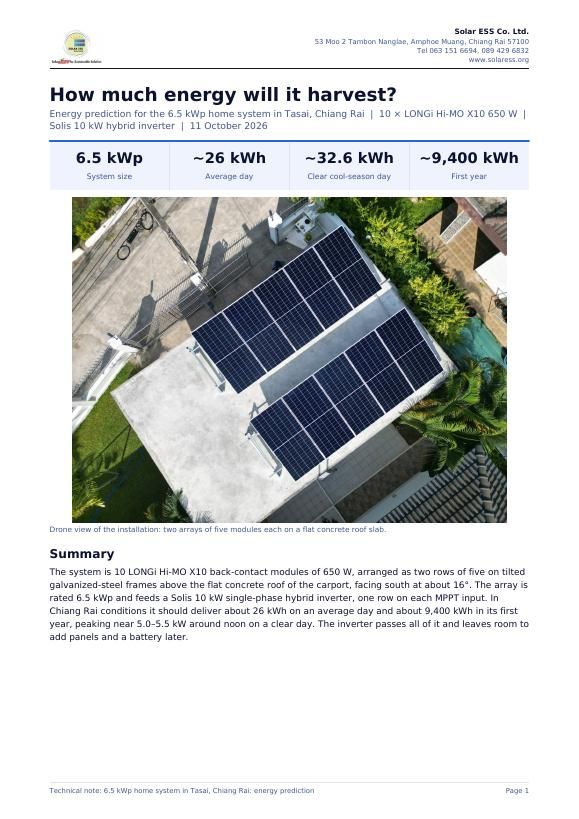
A worked prediction for a 10-panel hybrid system: what the panels should produce by the hour, the day, the season and over 30 years.

  • About 26 kWh on an average day and about 9,400 kWh in the first year
  • Hour-by-hour output on a clear day, and what heat, haze and rain change
  • Why the panels are wired as two strings of five, checked against the inverter limits
  • LONGi Hi-MO X10 and Solis hybrid inverter datasheets attached

Inverters & string design 8 notes

First page of the 10–16 kW single-phase hybrid inverter comparison

Comparison report · 3 pages · PDF · English, Thai

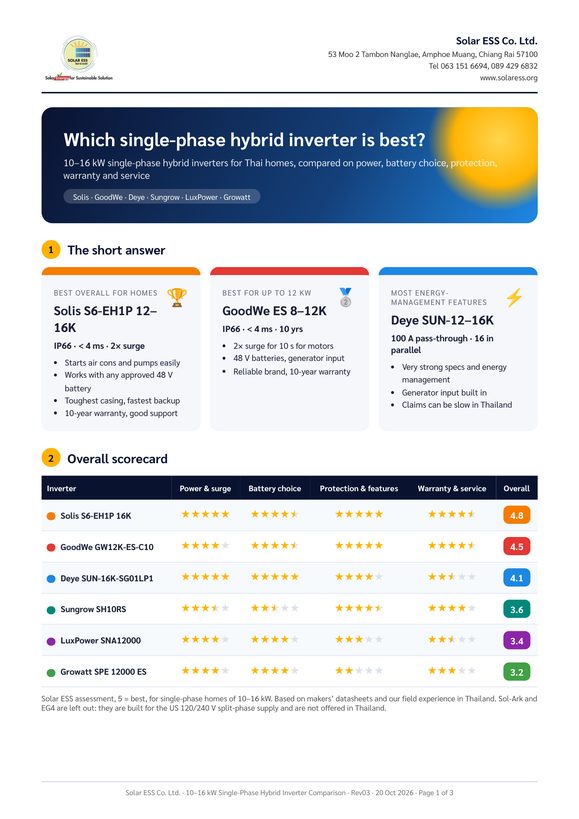
Which single-phase hybrid inverter is best?

10–16 kW single-phase hybrid inverters for Thai homes compared on power and surge, battery choice, protection and features, warranty and service: Solis, GoodWe, Deye, Sungrow, LuxPower and Growatt.

  • Overall scorecard and the best pick for each type of home
  • Rated power and starting-surge charts for air cons and pumps
  • Side-by-side technical specifications
  • Three golden rules before buying, and Thai rules to check
First page of “How likely is MPPT over-voltage with 650 W LONGi panels on a Huawei 50 kW inverter?”

Risk assessment · 2 pages · PDF · English, Thai

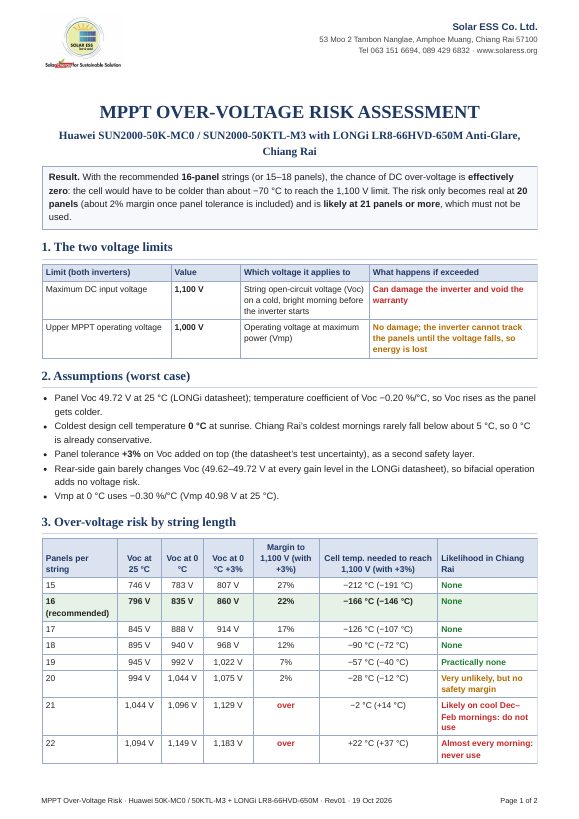
How likely is MPPT over-voltage with 650 W LONGi panels on a Huawei 50 kW inverter?

A worst-case check of string voltage against the 1,100 V input limit and the 1,000 V MPPT ceiling of the Huawei SUN2000-50K-MC0 and 50KTL-M3, for Chiang Rai’s coldest mornings.

  • Cold-morning open-circuit voltage for 15 to 22 panels per string, with +3% panel tolerance
  • How cold the panels would have to be to reach 1,100 V
  • Why 16-panel strings have a 22% margin and 21 panels must never be used
  • Wiring mistakes that cause over-voltage, and a commissioning voltage check
First page of “The most efficient string design for a Huawei SUN2000-50K-MC0 with LONGi 650 W panels”

Design note · 3 pages · PDF · English, Thai

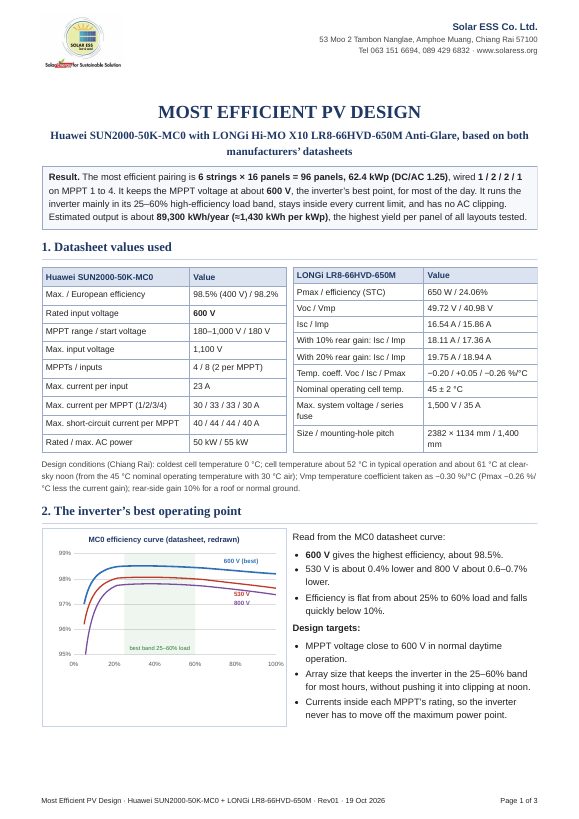
The most efficient string design for a Huawei SUN2000-50K-MC0 with LONGi 650 W panels

Built from both manufacturers’ datasheets: matching string voltage to the inverter’s 600 V sweet spot and its high-efficiency load band.

  • Reading the MC0 efficiency curve: 600 V and 25–60% load
  • Why 16 panels per string runs at about 603 V in typical operation
  • Current limits per MPPT with the panel’s published rear-gain values
  • Eight layouts compared by energy, yield per kWp, current limiting and clipping
First page of “Best-performance string design for a Huawei SUN2000-50KTL-M3 with LONGi 650 W panels”

Design note · 3 pages · PDF · English, Thai

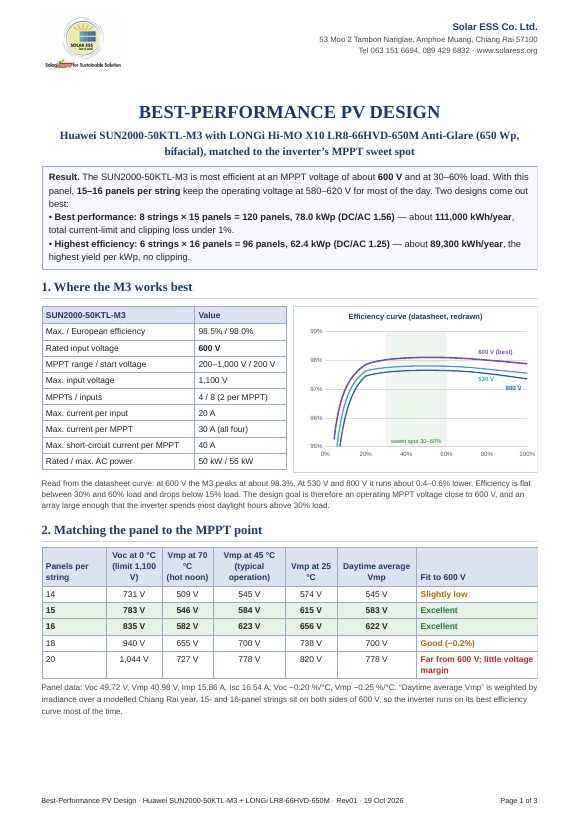
Best-performance string design for a Huawei SUN2000-50KTL-M3 with LONGi 650 W panels

Matching the panel to the M3’s 600 V MPPT sweet spot, within its tighter 30 A per-MPPT current limit.

  • Efficiency curve of the M3 redrawn from the datasheet
  • 15 and 16-panel strings either side of 600 V
  • Why two strings per MPPT is fine on a roof but not on a carport
  • Best performance (120 panels) against highest efficiency (96 panels)
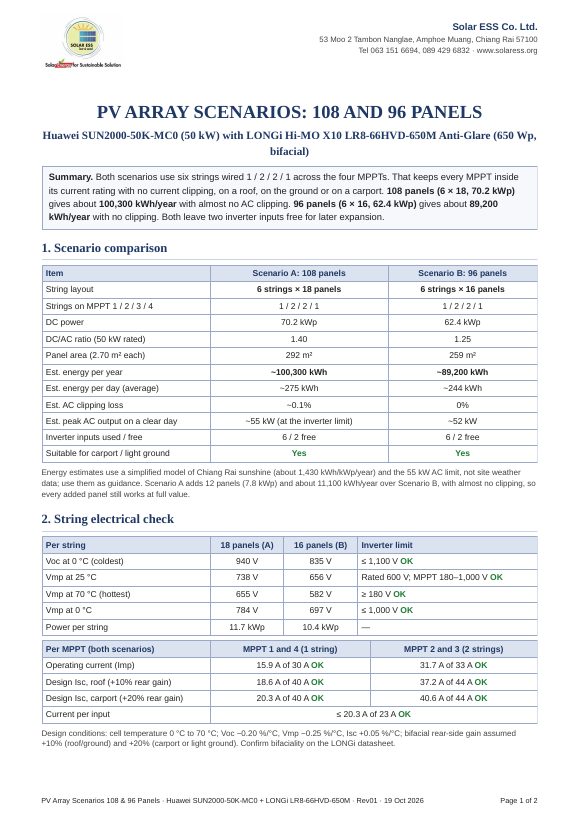
First page of “108 panels or 96 panels on a Huawei 50 kW inverter?”

Scenario comparison · 2 pages · PDF · English, Thai

108 panels or 96 panels on a Huawei 50 kW inverter?

Two array sizes for the Huawei SUN2000-50K-MC0 with LONGi 650 W panels, both wired 1/2/2/1 so every MPPT stays inside its current rating.

  • 70.2 kWp against 62.4 kWp: DC/AC ratio, energy per year and clipping
  • String voltage and current checks for 18 and 16-panel strings
  • String layout diagrams for both scenarios
  • Room to grow with the two free inverter inputs
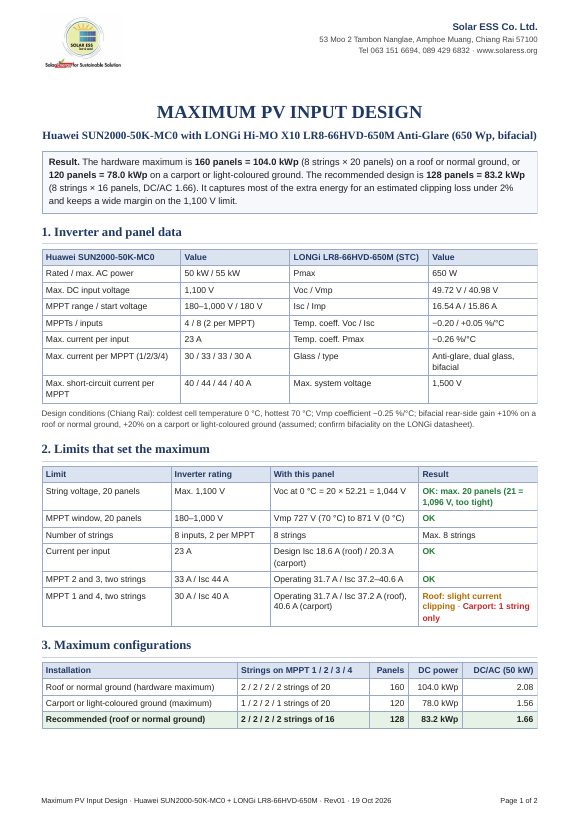
First page of “How many LONGi 650 W panels can a Huawei SUN2000-50K-MC0 take?”

Design note · 2 pages · PDF · English, Thai

How many LONGi 650 W panels can a Huawei SUN2000-50K-MC0 take?

The hardware maximum and a recommended size, with the voltage and current limits that set them and the energy lost to clipping at each step.

  • Hardware maximum: 160 panels (104 kWp) on a roof, 120 on a carport
  • Recommended: 128 panels (83.2 kWp, DC/AC 1.66)
  • Energy and clipping loss from 108 to 160 panels
  • Cabling notes: solar cable, DC connectors and surge protection
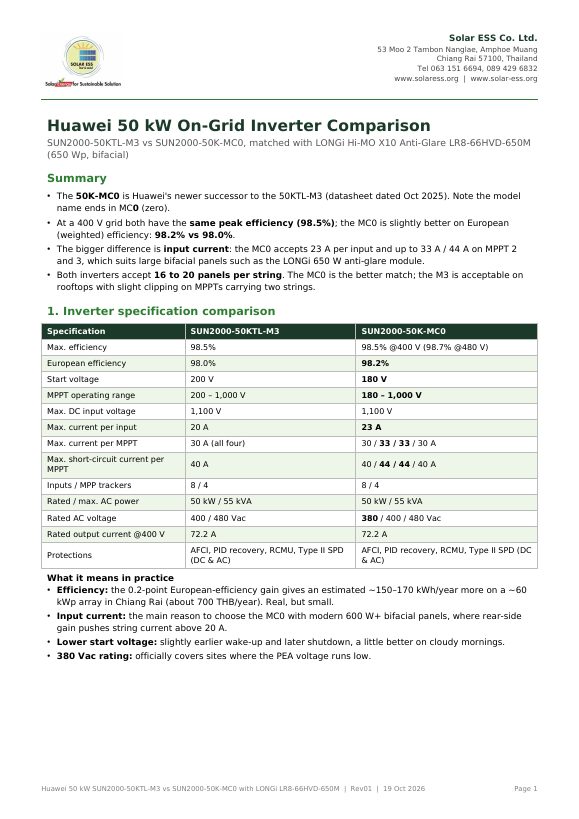
First page of “Huawei 50 kW inverters compared: SUN2000-50KTL-M3 against SUN2000-50K-MC0”

Product comparison · 3 pages · PDF · English, Thai

Huawei 50 kW inverters compared: SUN2000-50KTL-M3 against SUN2000-50K-MC0

Specifications, efficiency and string design for both models with LONGi Hi-MO X10 650 W anti-glare bifacial panels.

  • Efficiency, start voltage, MPPT range and current limits side by side
  • String voltage check: 16 to 20 panels per string
  • Where the MC0’s higher input current matters with bifacial panels
  • Three recommended layouts and which model to choose
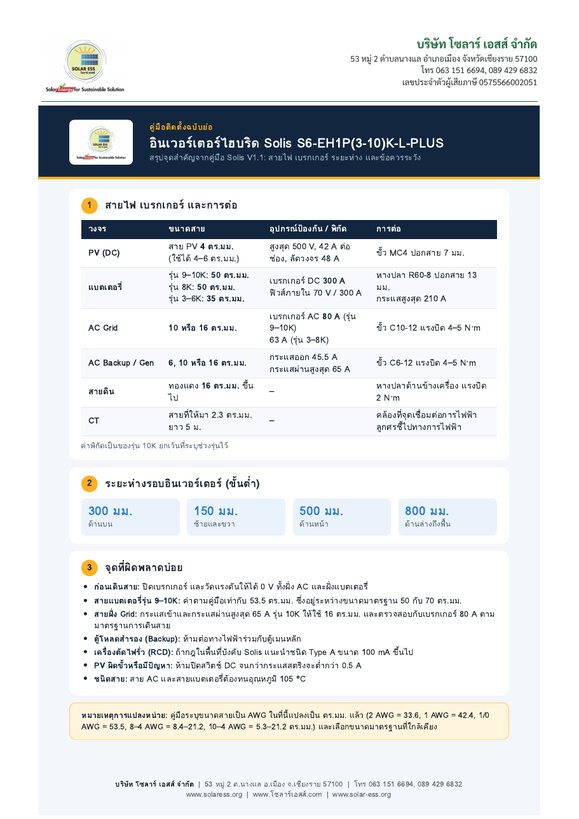
หน้าแรกของคู่มือติดตั้งฉบับย่อ Solis S6-EH1P

คู่มือติดตั้ง · 1 หน้า · PDF · ภาษาไทย

คู่มือติดตั้งฉบับย่อ อินเวอร์เตอร์ไฮบริด Solis S6-EH1P

สรุปจุดสำคัญจากคู่มือ Solis V1.1 สำหรับช่างติดตั้งและเจ้าของบ้าน

  • ขนาดสายไฟและพิกัดเบรกเกอร์ของแต่ละวงจร
  • ระยะห่างในการติดตั้ง
  • ข้อควรระวังที่พบบ่อยหน้างาน

Zero export & phase balance 6 notes

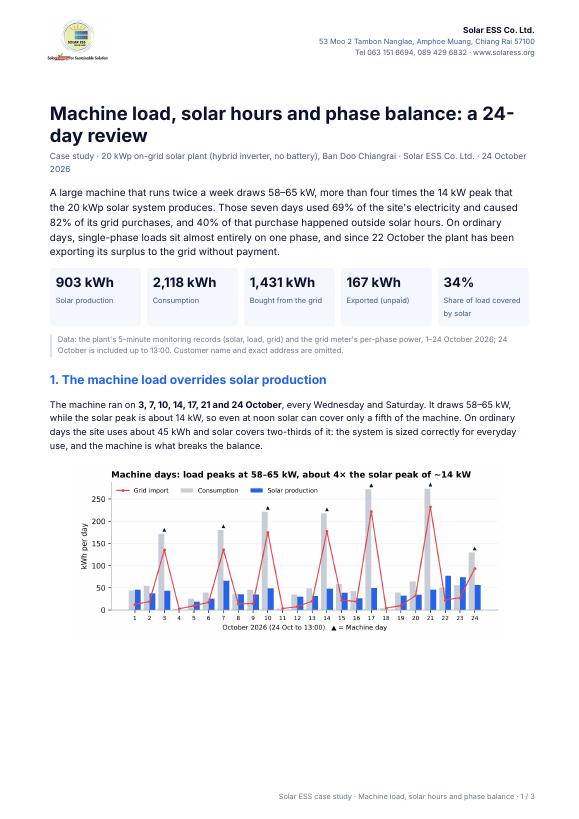
First page of the machine load, solar hours and phase balance case study

Case study · 3 pages · PDF · English, Thai

Machine load, solar hours and phase balance: a 24-day review

Five-minute monitoring data from a 20 kWp on-grid plant in Chiang Rai, 1–24 October 2026, where a 60 kW machine runs twice a week.

  • Machine days: 69% of consumption and 82% of grid purchases
  • 40% of machine-day purchases happen before 09:00 or after 16:00
  • Everyday single-phase loads on L1 (68%), L2 almost empty (4%)
  • What to do: machine hours 08:30–16:00, TOU check, phase rebalancing, zero export or a battery
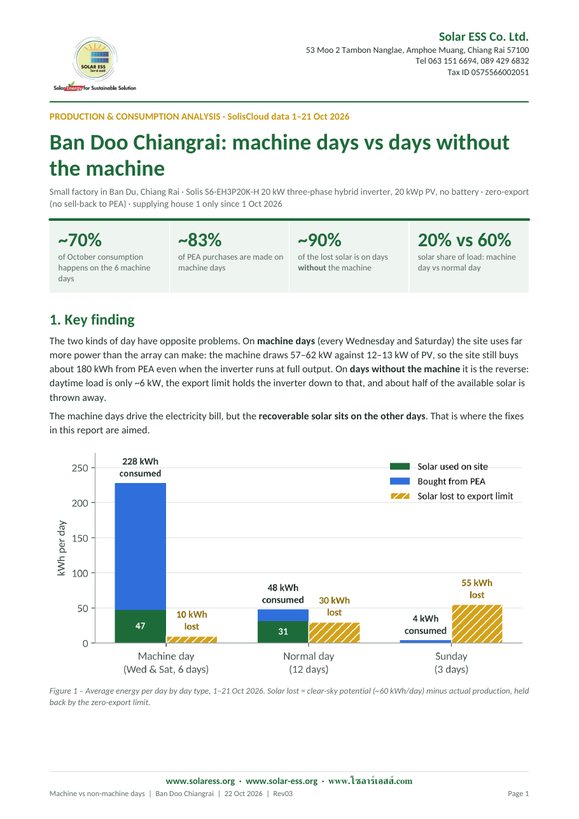
First page of the machine days vs non-machine days report

Case study · 5 pages · PDF · English

A 20 kWp zero-export plant: machine days vs days without the machine

A small factory in Chiang Rai runs a 57–62 kW machine two days a week. Solar can cover only a fifth of the machine, while almost all the curtailed solar is lost on the days without it. This report analyses both kinds of day and sets out what to do.

  • Production, consumption and PEA purchases by day type
  • Modelled daily profiles: where the curtailed energy goes
  • Phase imbalance and neutral current
  • Actions by day type and battery sizing
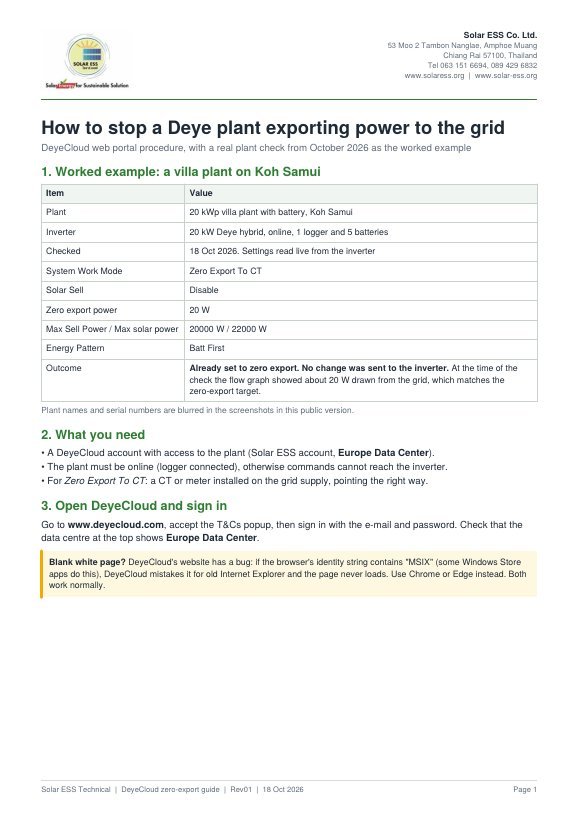
First page of the DeyeCloud zero-export guide

How-to guide · 4 pages · PDF · English

How to stop a Deye plant exporting power to the grid (DeyeCloud)

A step-by-step guide to checking and setting zero export on a Deye hybrid inverter from the DeyeCloud web portal, with a 20 kWp villa plant on Koh Samui as the worked example.

  • Where to find Device Control and System Work Mode-1
  • The three settings that stop export: Zero Export To CT, Solar Sell Disable, zero export power about 20 W
  • How to read, set and confirm the change, and check export has stopped
  • Fix for the blank DeyeCloud page in some Windows apps
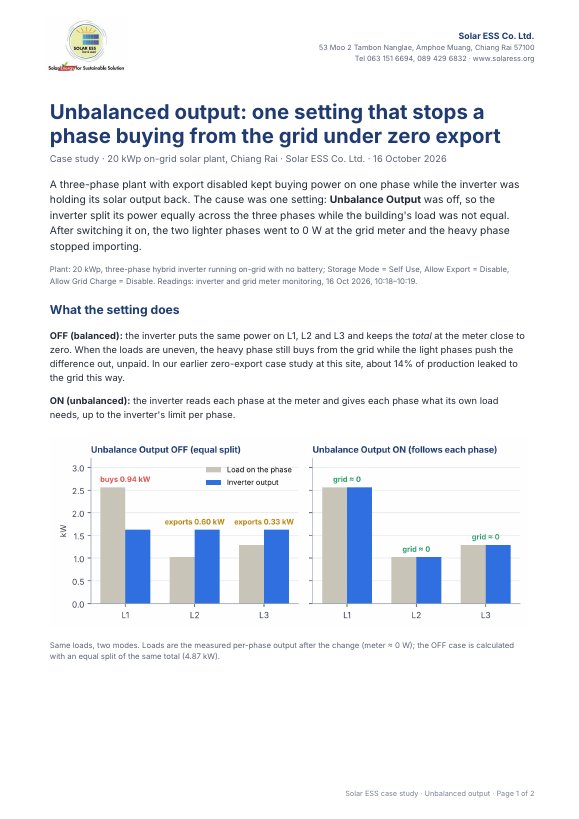
First page of the unbalanced output case study

Case study · 2 pages · PDF · English

Unbalanced output: one setting that stops a phase buying from the grid under zero export

A 20 kWp three-phase on-grid plant in Chiang Rai with export disabled kept buying power on one phase while its solar was held back. Switching on the inverter's Unbalance Output setting fixed it.

  • Balanced vs unbalanced output, shown with the plant's own per-phase loads
  • After the change: two phases at 0 W at the grid meter, the heavy phase no longer importing
  • Why the meter still shows amps at 0 W (reactive current)
  • Five checks before you rely on it: read-back, installer access, CTs, phase order, per-phase limit
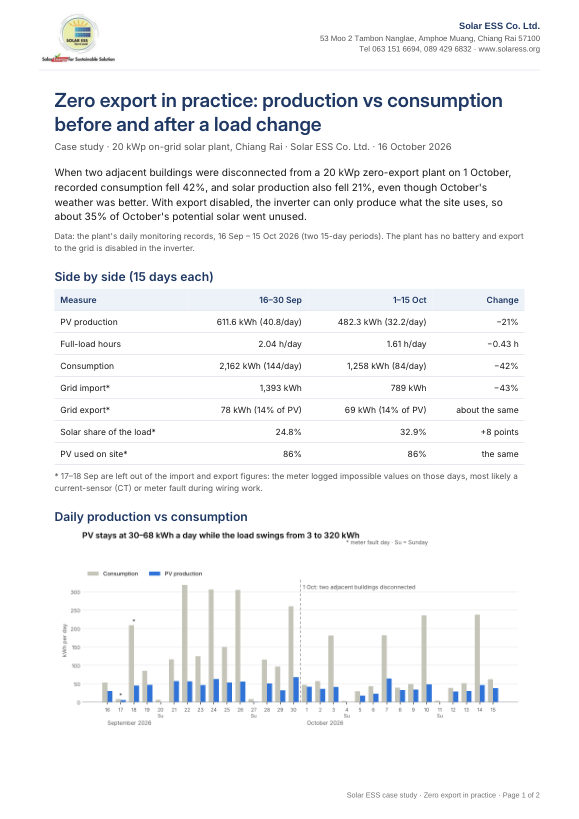
First page of the zero-export production vs consumption case study

Case study · 2 pages · PDF · English

Zero export in practice: why a plant's solar output fell when its load fell

A 20 kWp on-grid plant in Chiang Rai, compared over two 15-day periods before and after two adjacent buildings were disconnected. With export disabled, the inverter can only produce what the site uses.

  • Consumption fell 42%, and solar production fell 21% despite better weather
  • About 35% of October's potential solar went unused on light days and Sundays
  • Why a phase imbalance lets “zero export” still leak about 14% of production
  • What to do: phase balancing, load shifting, PEA sell-back or a small battery
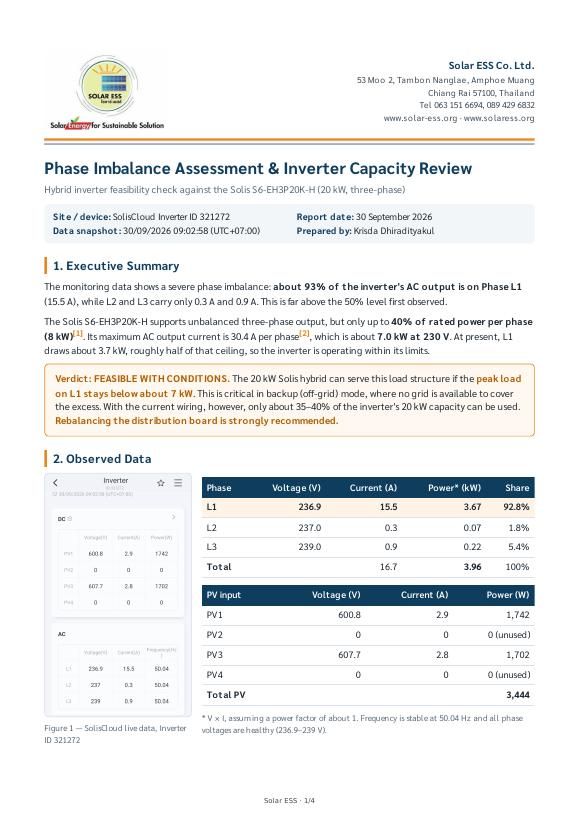
First page of the phase imbalance report

Case study · 4 pages · PDF · English, Thai

Phase imbalance and inverter capacity review

A review of a Solis 20 kW three-phase hybrid system where most of the load sits on one phase.

  • How the load on each phase compares with the inverter's limits
  • What severe single-phase loading does to a hybrid inverter
  • Why rebalancing the distribution board is the recommended fix

Batteries 3 notes

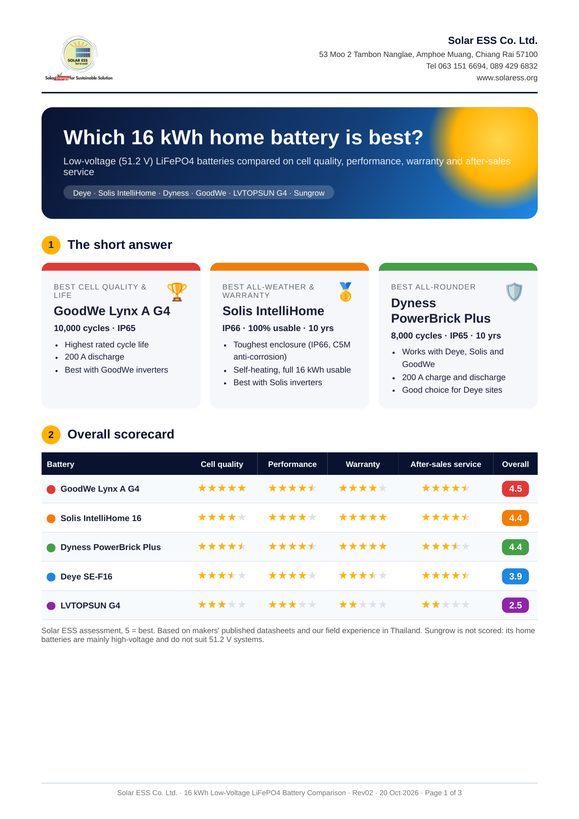
First page of the 16 kWh low-voltage battery comparison

Comparison report · 3 pages · PDF · English, Thai

Which 16 kWh home battery is best?

Six low-voltage (51.2 V) LiFePO4 batteries compared on cell quality, performance, warranty and after-sales service: Deye, Solis IntelliHome, Dyness, GoodWe, LVTOPSUN G4 and Sungrow.

  • Overall scorecard and the best pick for each inverter brand
  • Cycle life and usable energy charts
  • Side-by-side technical specifications
  • Warranty, after-sales service and inverter compatibility
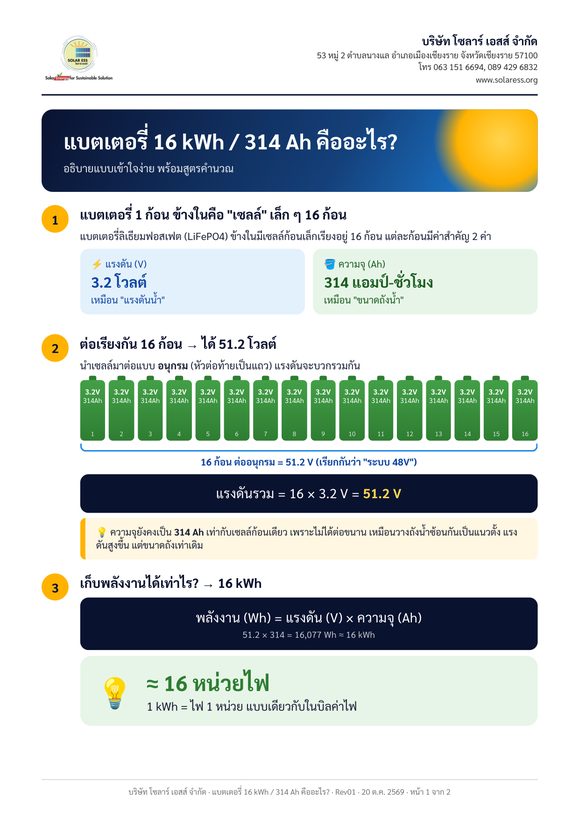
First page of the 16 kWh / 314 Ah battery explainer

Customer explainer · 2 pages · PDF · Thai

What is a 16 kWh / 314 Ah battery?

A simple guide, with formulas, to how 16 LiFePO4 cells of 3.2 V and 314 Ah make a 51.2 V, 16 kWh battery, how much of it you can really use, and how many hours it runs an air con.

  • 16 cells × 3.2 V in series = 51.2 V (the "48 V system")
  • 51.2 V × 314 Ah ≈ 16 kWh, about 16 units of electricity
  • Usable energy by depth of discharge (90 to 100%)
  • Runtime for air cons and household loads
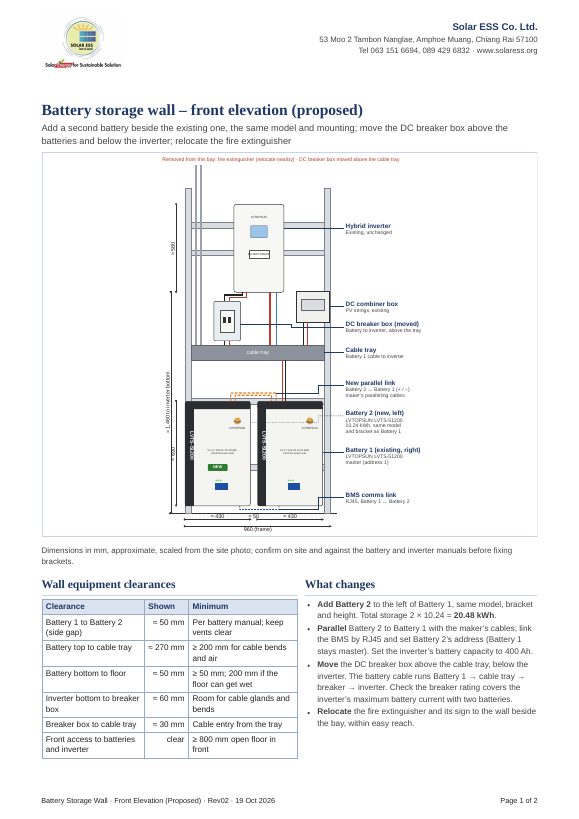
First page of the battery wall front elevation

Drawing · 2 pages · PDF · English, Thai

Adding a second wall battery: front elevation

A proposed layout for adding a second 10.24 kWh LiFePO4 wall battery beside the first, under a hybrid inverter, with the DC breaker box moved between the inverter and the batteries.

  • Dimensioned front elevation with every item labelled
  • Paralleling the two batteries: power cables, BMS link and master address
  • Clearances around batteries, breaker box, cable tray and inverter
  • Site photo next to an edited photo of the proposed wall

Solar panels & tilt 3 notes

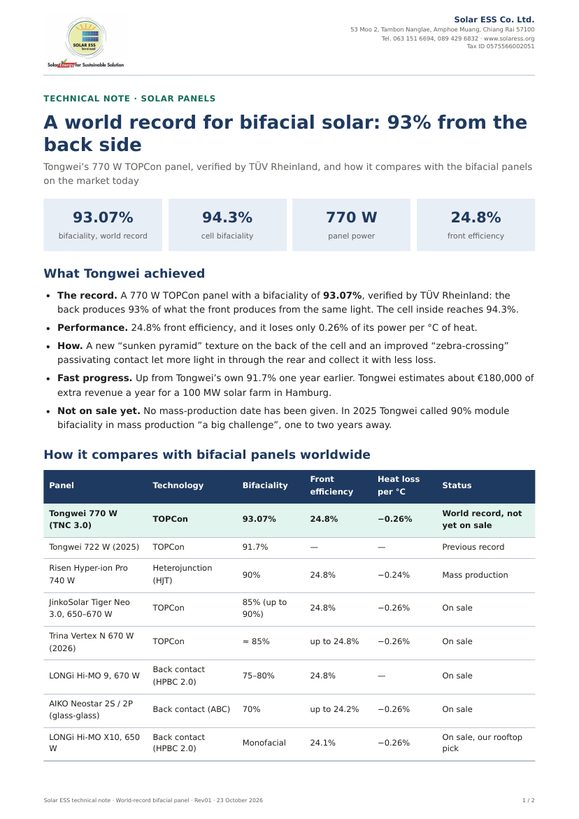
First page of the world-record bifacial panel comparison

Panel comparison · 2 pages · PDF · English

A world record for bifacial solar: 93% from the back side

Tongwei’s 770 W TOPCon panel reached 93.07% bifaciality, verified by TÜV Rheinland: the back produces 93% of what the front does. We compare it with the bifacial panels on sale today and show where the extra output really counts in Thailand.

  • Record figures: 93.07% panel and 94.3% cell bifaciality, 24.8% efficiency
  • Comparison with Risen HJT (90%), Jinko and Trina TOPCon (≈85%), LONGi and AIKO back-contact (70–80%)
  • Extra energy on a roof, a carport and a ground mount
  • Which panel to choose for rooftops and for open structures
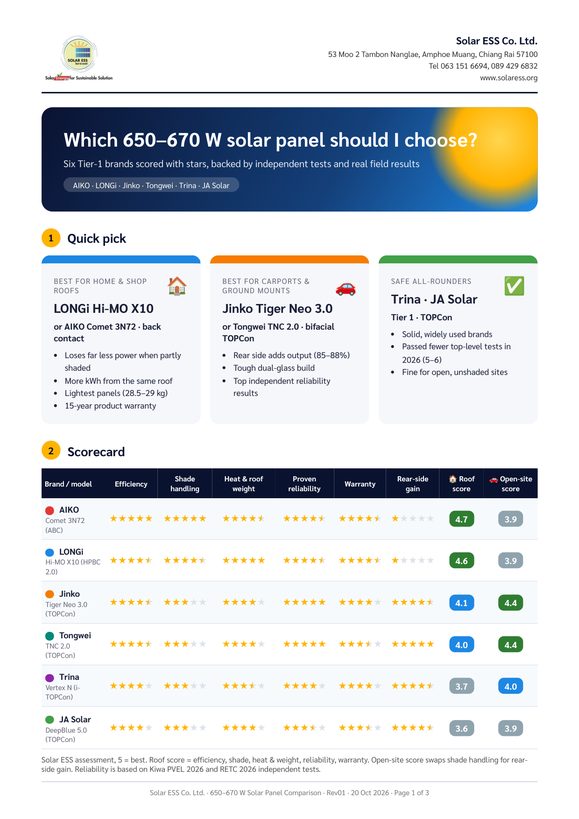
First page of the 650–670 W solar panel comparison

Comparison report · 3 pages · PDF · English, Thai

Which 650–670 W solar panel should I choose?

Six Tier-1 panels scored with stars for rooftops and for open sites: AIKO, LONGi, Jinko, Tongwei, Trina and JA Solar, backed by independent tests (Kiwa PVEL 2026, RETC 2026, TÜV) and real field results.

  • Quick pick for home roofs, carports and ground mounts
  • Star scorecard with roof and open-site scores
  • Independent test results and field cases from both technologies
  • Key specifications and a 30-second decision guide
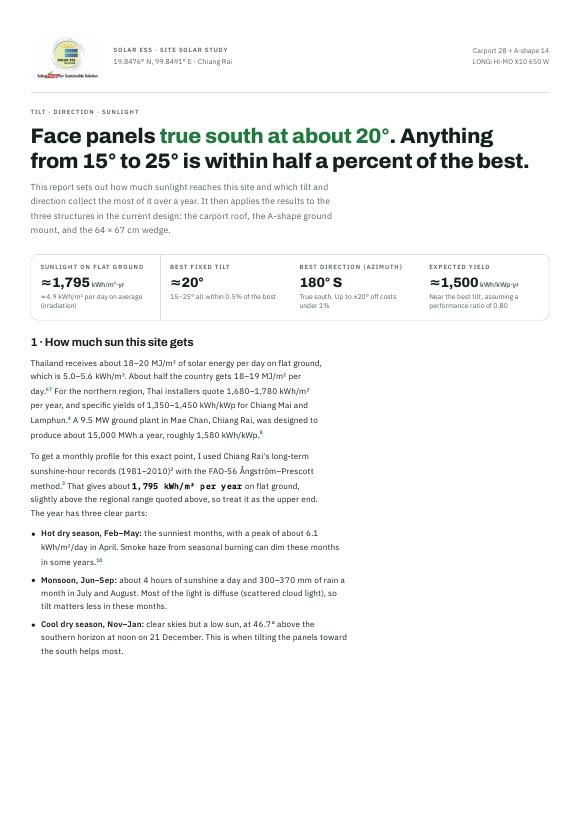
First page of the Chiang Rai panel angle study

Site study · 5 pages · PDF · English, Thai, Dutch

Face south at about 20°: panel tilt and direction in Chiang Rai

How much sunlight reaches Chiang Rai, and which panel tilt and direction collect the most over a year.

  • Anything from 15° to 25° is within half a percent of the best tilt
  • What facing east or west costs in yearly energy
  • The results applied to a carport roof and an A-shape ground mount

Structures & footings 7 notes

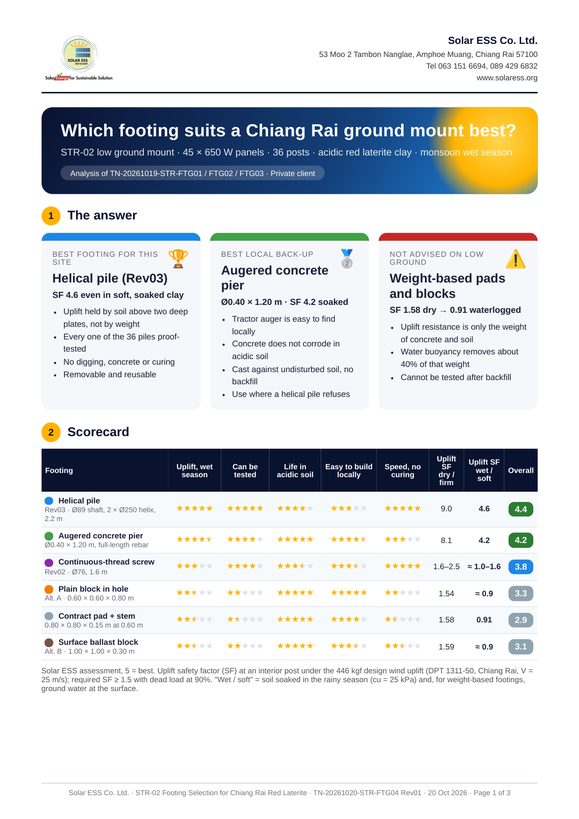
First page of the footing selection analysis for a Chiang Rai ground mount

Engineering note · 3 pages · PDF · English

Which footing suits a Chiang Rai ground mount best?

Six footings for a 36-post low ground mount on acidic red laterite clay compared on wind uplift in the wet season, testing, durability and buildability. Shows why weight-based pads can drop below a safety factor of 1.0 on waterlogged ground, and why helical piles and augered concrete piers stay above 4.

  • Star scorecard and uplift safety factors, dry and soaked
  • Buoyancy effect on concrete pads in the monsoon
  • Independent check of the helical pile design
  • Recommended footing plan and drainage
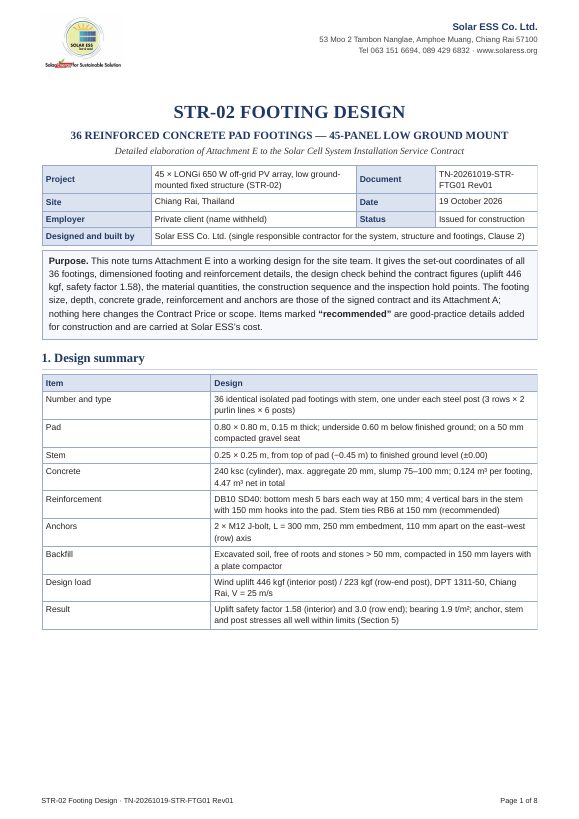
First page of the STR-02 pad footing design

Design note · 8 pages · PDF · English, Thai

Pad footings for a 45-panel low ground mount, designed for wind uplift

A construction-ready design for 36 reinforced concrete pad footings under a low, fixed ground-mounted array of 45 × 650 W panels in Chiang Rai.

  • Set-out plan with coordinates for every footing and diagonal checks
  • Footing section and plan with reinforcement, anchor bolts and base plate
  • Wind uplift to DPT 1311-50: 446 kgf per post, safety factor 1.58
  • Material quantities, a ten-step build sequence with hold points, and tolerances
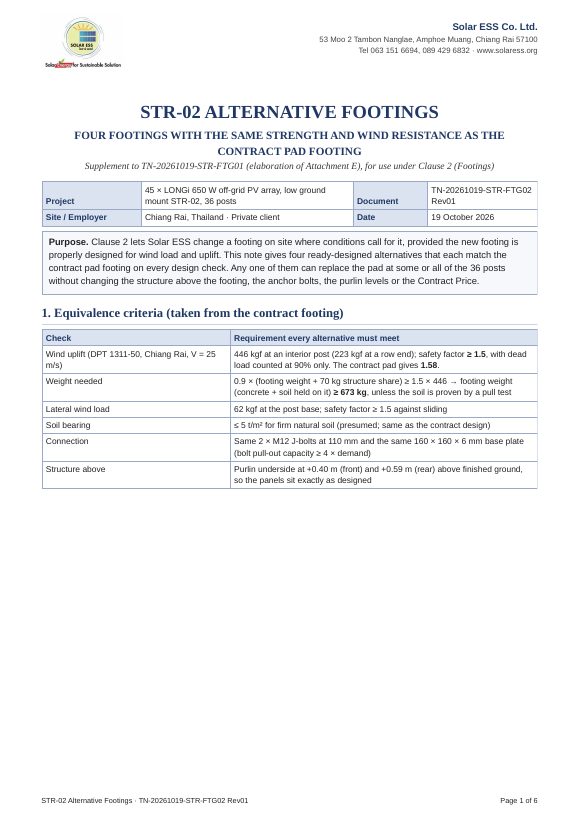
First page of the alternative footings note

Design note · 6 pages · PDF · English

Four footings with the same wind resistance as a concrete pad

Alternatives to a buried pad footing that carry the same uplift and lateral wind load, for sites with rock, water, soft ground or limited labour.

  • Plain concrete block cast in the hole: one pour, no formwork
  • Shallow ballast block for rock or high water near the surface
  • Augered concrete pier and steel ground screw, with site pull tests
  • Which footing to use for each site condition
First page of the ground-mount structure bill of materials

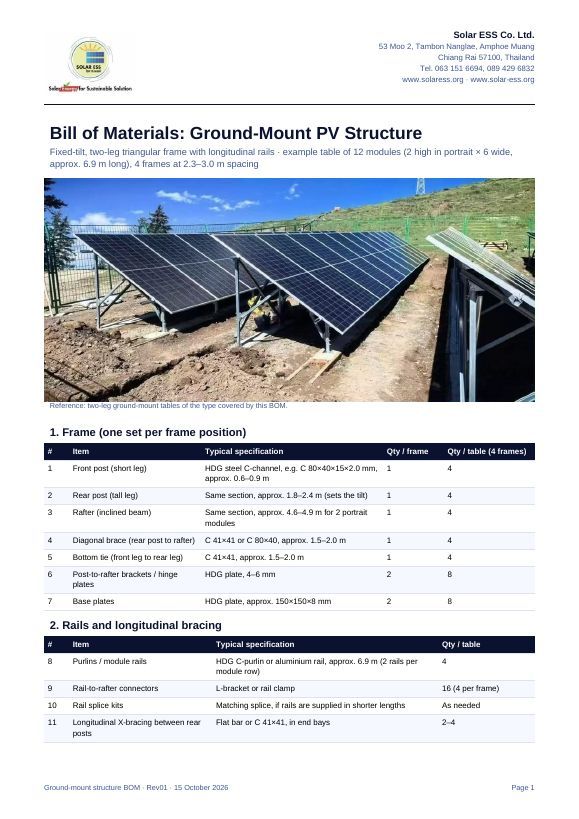
Bill of materials · 2 pages · PDF · English

What goes into a ground-mount solar structure? A complete bill of materials

Every part of a fixed-tilt, two-leg ground-mount table, from posts and rails to clamps, footings and earthing, with typical sizes and quantities for an example 12-module table.

  • Frame, rails, bracing, module clamps and fasteners, item by item
  • Foundation options: concrete footings or ground screws
  • Earthing and bonding parts, with an earth rod at each end of the table
  • What to check before ordering: tilt, clearance, wind load and galvanizing
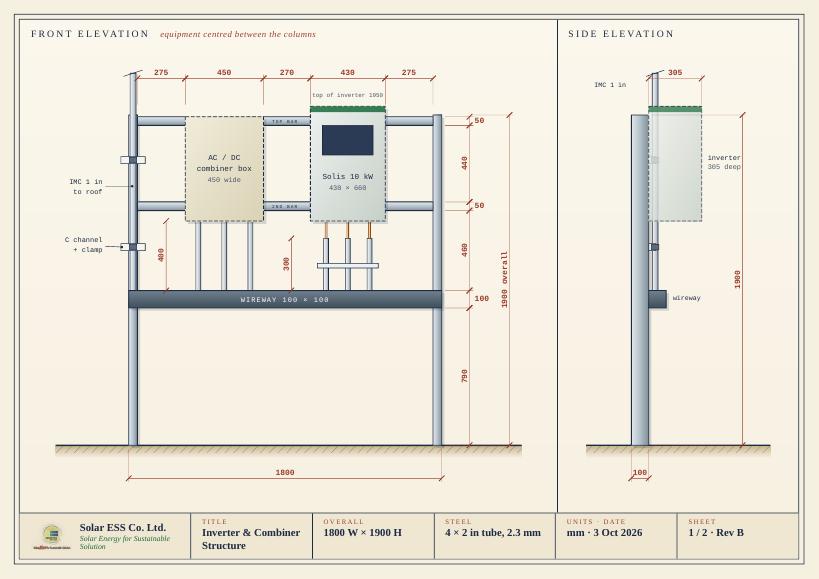
Front and side elevation of the inverter and combiner structure

Inverter & Combiner Structure · 2 sheets · PDF · English

Inverter & Combiner Structure

A free-standing steel frame, 1800 wide by 1900 high, that carries the hybrid inverter, the AC/DC combiner box and the wireway in one tidy assembly.

  • Front and side elevations with every dimension in millimetres
  • Inverter and combiner box spaced evenly between the columns
  • Wireway, EMT drops and the IMC riser to the roof
  • Member list with sections, quantities and cut lengths
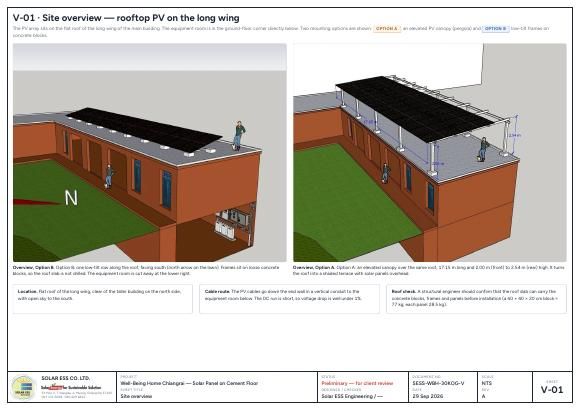
First page of the Solar panels on cement floor package

Design case study · 5 pages · PDF · English

Solar panels on a cement floor: canopy or low-tilt frames

Two ways to mount panels on the same flat concrete roof, both on precast concrete blocks with no drilling into the slab.

  • Option A: a raised PV canopy that doubles as a shaded terrace
  • Option B: low-tilt steel frames about 0.5 m high
  • Height, wind load, steel, cost and maintenance access compared
  • Block, rubber pad and anchor plate detail that keeps the waterproofing intact
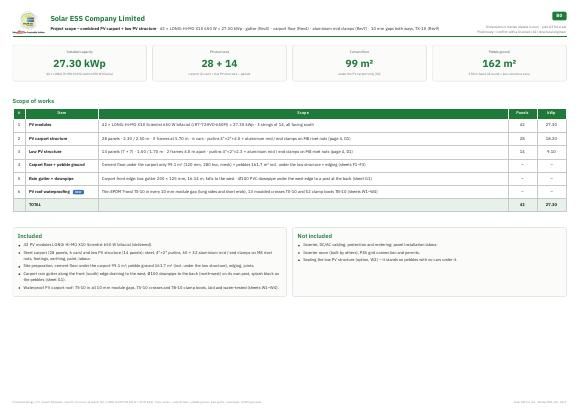
First page of the PV carport and low structure design package

Design package · 13 pages · PDF · English

Combined PV carport and low PV structure, 27.30 kWp

A full engineering package for a six-car PV carport with a low PV structure beside it, using 42 LONGi Hi-MO X10 650 W panels.

  • Carport for 28 panels and low structure for 14 panels
  • Floor works, rain gutter and drainage
  • Mid clamps and sealed gaps between panels for a dry carport

Safety & protection 8 notes

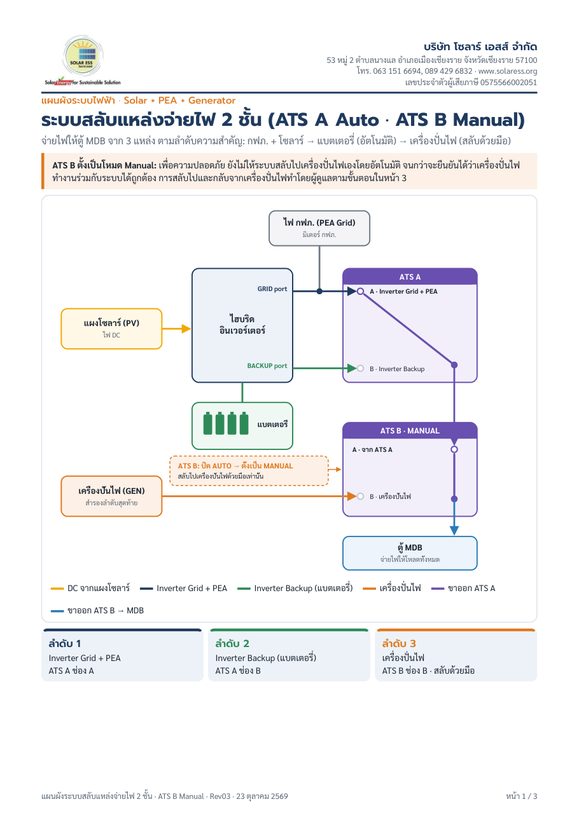
First page of the two-stage ATS switching diagram

Wiring diagram · 3 pages · PDF · Thai

Two-stage source switching: solar + PEA, battery, then generator

How one main board (MDB) is fed from three sources in order of priority. ATS A switches automatically between the hybrid inverter's grid port and its battery backup port; ATS B, set to manual, brings in the generator only when an operator decides to.

  • Single-line diagram of PV, hybrid inverter, battery, PEA meter, generator, ATS A and ATS B
  • The three operating modes: PEA normal, PEA outage, battery low
  • Step-by-step manual switching to and from the generator
  • Eight installation rules: break-before-make, mechanical interlock, 4-pole ATS, ratings, retransfer delay
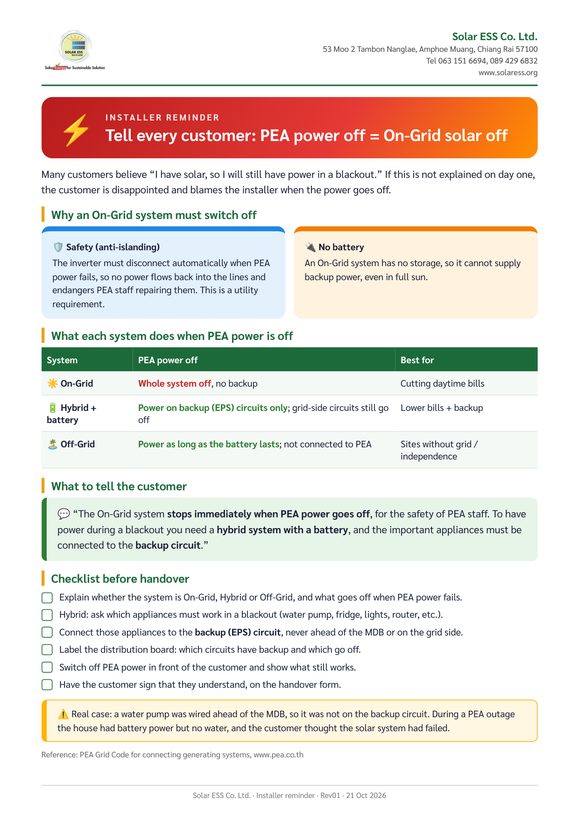
Installer reminder: PEA power off means On-Grid solar off

Installer reminder · 1 page · PDF · English, Thai

Tell every customer: PEA power off = On-Grid solar off

A one-page reminder for installers. On-Grid inverters must switch off when PEA power fails (anti-islanding), and only the backup (EPS) circuits of a hybrid system keep power. Explain it before handover so customers are not surprised in a blackout.

  • Why On-Grid systems switch off
  • What On-Grid, Hybrid and Off-Grid systems do in a PEA outage
  • What to tell the customer
  • Six-step checklist before handover
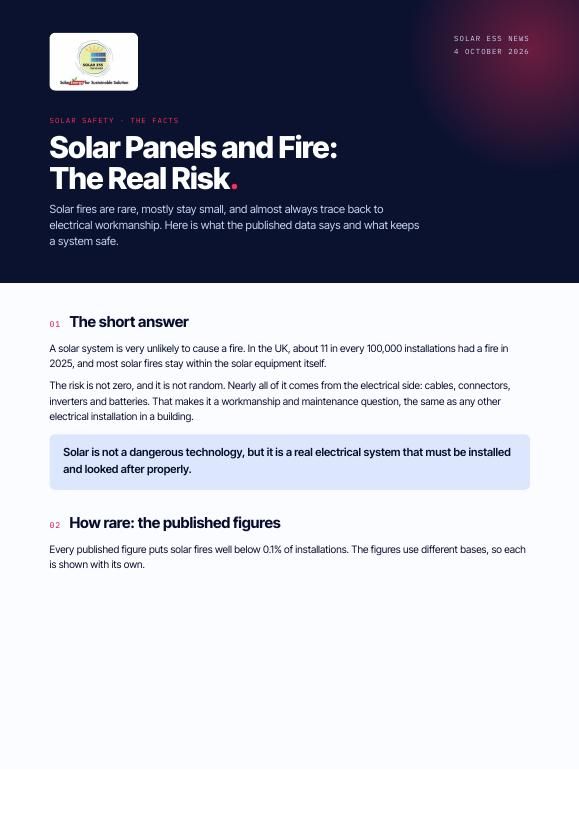
First page of the Solar panels and fire report

Fire and life safety · 4 pages · PDF · English, Thai

Solar panels and fire: the real risk

Solar fires are rare, mostly stay small, and almost always trace back to electrical workmanship, not the panels themselves.

  • How often solar systems are involved in a fire
  • Where solar fires start and why
  • What good installation and yearly maintenance do to the risk
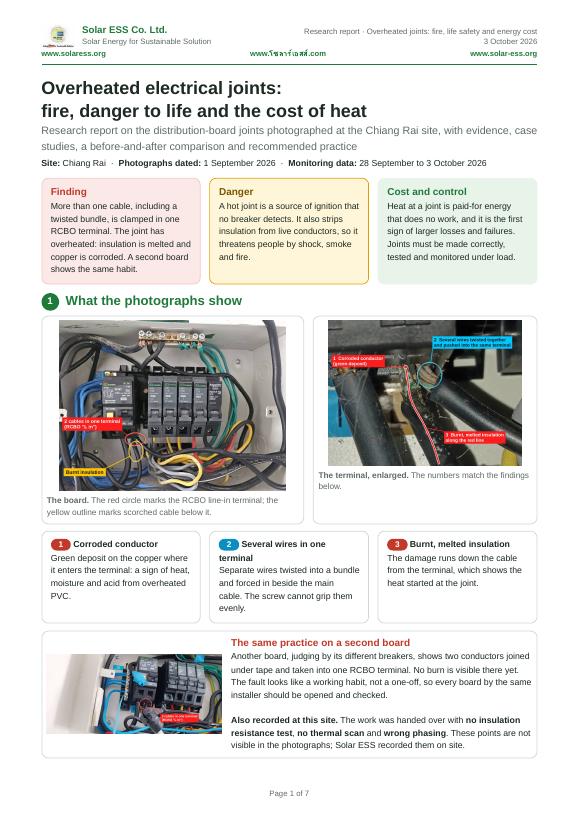
First page of the research report on overheated electrical joints

Electrical safety · 7 pages · PDF · English

Overheated joints: fire, danger to life and the cost of heat

Warning: a loose connection can burn at over 1,200 °C and no breaker will trip. This report follows one real terminal in Chiang Rai from poor workmanship to melted insulation, and shows how to find the same fault in your own board before it finds you.

  • Photographs of two cables forced into one terminal, and what the heat did
  • Fire statistics and case studies from Bangkok, London and China
  • Fire risk and risk to life compared, and the joint before and after repair
  • How heat at a joint wastes energy you pay for
  • A preventive maintenance routine: correct torque, insulation test, and a thermal scan under load every year

Have your boards not been scanned in the last year? Read this, then book an inspection.

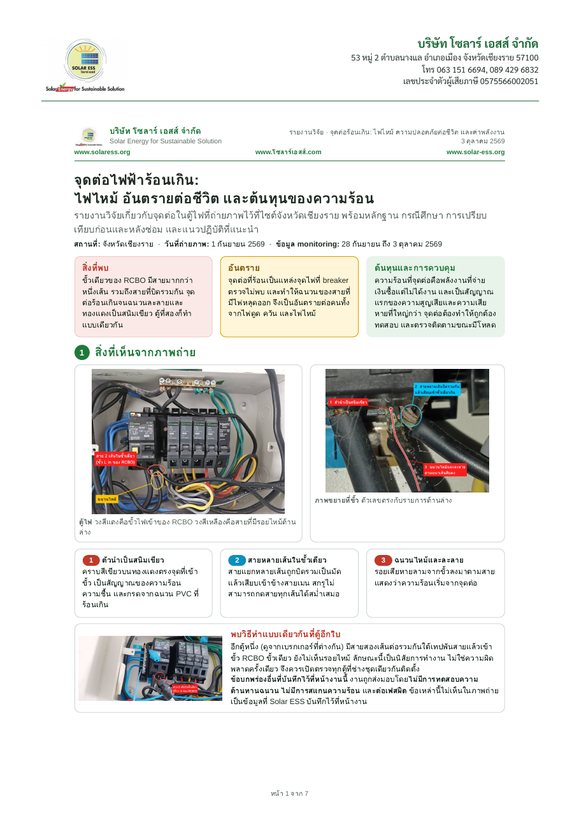
หน้าแรกของรายงานวิจัยเรื่องจุดต่อไฟฟ้าร้อนเกิน ฉบับภาษาไทย

ความปลอดภัยทางไฟฟ้า · 7 หน้า · PDF · ภาษาไทย

จุดต่อไฟฟ้าร้อนเกิน: ไฟไหม้ อันตรายต่อชีวิต และต้นทุนของความร้อน ฉบับภาษาไทย

คำเตือน: จุดต่อที่หลวมร้อนได้เกิน 1,200 °C โดยที่ breaker ไม่ตัด รายงานฉบับนี้ติดตามขั้วสายจริงหนึ่งจุดในเชียงราย ตั้งแต่งานติดตั้งที่ไม่ได้มาตรฐานจนฉนวนละลาย และบอกวิธีตรวจหาปัญหาแบบเดียวกันในตู้ไฟของคุณก่อนจะสายเกินไป

  • ภาพถ่ายสายสองเส้นที่อัดเข้าขั้วเดียว และผลของความร้อนที่เกิดขึ้น
  • สถิติไฟไหม้และกรณีศึกษาจากกรุงเทพฯ ลอนดอน และจีน
  • เปรียบเทียบอันตรายจากไฟไหม้กับอันตรายต่อชีวิต และสภาพก่อนกับหลังซ่อม
  • ความร้อนที่จุดต่อทำให้เสียพลังงานที่คุณจ่ายเงินซื้ออย่างไร
  • แนวทางบำรุงรักษาเชิงป้องกัน: ขัน torque ให้ถูกต้อง ทดสอบฉนวน และทำ thermal scan ขณะมีโหลดทุกปี

ตู้ไฟของคุณไม่ได้สแกนความร้อนมาเกินหนึ่งปีแล้วหรือไม่ อ่านรายงานนี้ แล้วนัดตรวจกับเรา

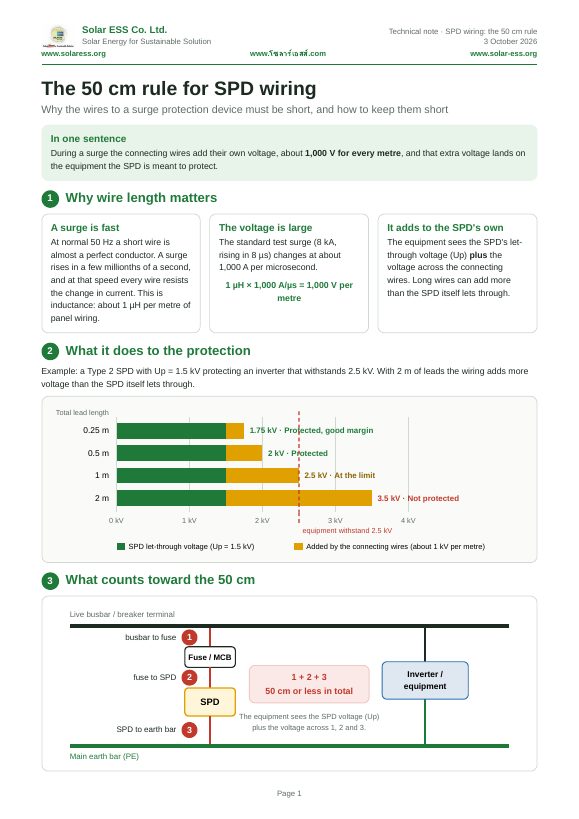
First page of the 50 cm rule note

Surge protection · 2 pages · PDF · English

The 50 cm rule for SPD wiring

Why the wires to a surge protection device must be short, and how to keep them short in a real board.

  • Why every metre of connecting wire adds about 1,000 V during a surge
  • What the equipment sees with 0.25 m, 0.5 m, 1 m and 2 m of leads
  • Which three lengths count toward the 50 cm
  • V-connection, local earth terminal and other ways to keep it short
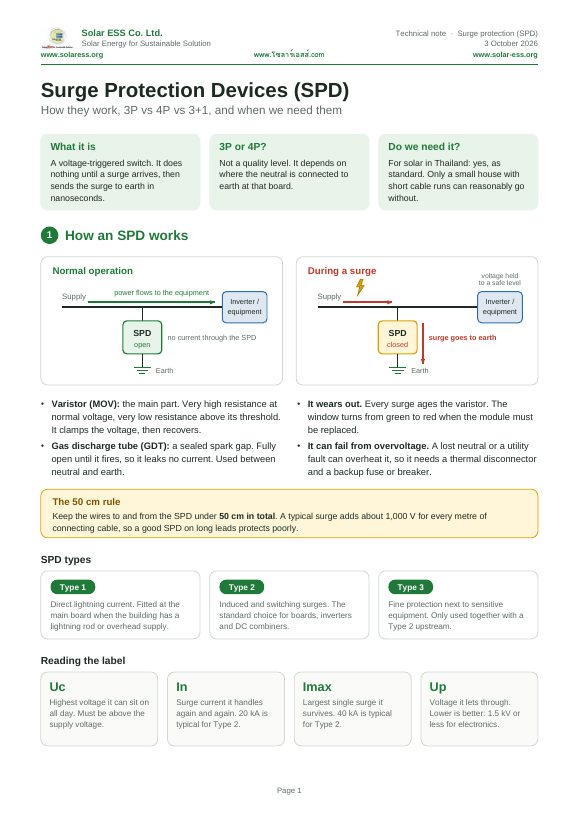
First page of the Surge Protection Devices guide

Surge protection · 4 pages · PDF · English · มีฉบับภาษาไทย

Surge Protection Devices (SPD): 3P, 4P and 3+1

How an SPD works, what is different between 3P, 4P and 3+1 devices, and when a solar system needs one.

  • How a surge is sent to earth, and how to read the ratings on the label
  • Which device fits which earthing arrangement, with a quick chooser
  • When the standards require an SPD, and what that means in Thailand
  • Where SPDs go in a solar system, and a five-point checklist
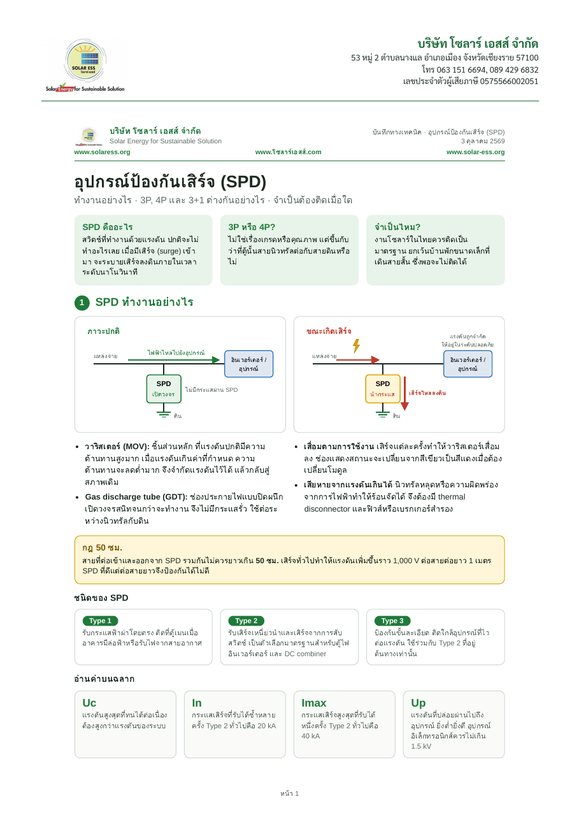
หน้าแรกของคู่มืออุปกรณ์ป้องกันเสิร์จ (SPD) ฉบับภาษาไทย

อุปกรณ์ป้องกันเสิร์จ · 4 หน้า · PDF · ภาษาไทย

อุปกรณ์ป้องกันเสิร์จ (SPD): 3P, 4P และ 3+1 ฉบับภาษาไทย

ฟ้าผ่าครั้งเดียวอาจทำให้อินเวอร์เตอร์ราคาหลักแสนเสียหายได้ คู่มือฉบับนี้อธิบายเป็นภาษาไทยแบบเข้าใจง่าย พร้อมภาพประกอบ ว่า SPD ทำงานอย่างไร และควรเลือกแบบใดให้เหมาะกับตู้ไฟของคุณ

  • SPD แบบ 3P, 4P และ 3+1 ต่างกันอย่างไร และตู้ไฟแบบไหนควรใช้แบบใด
  • งานโซลาร์ในไทยจำเป็นต้องติด SPD หรือไม่ และติดตรงจุดใดบ้าง
  • กฎ 50 ซม. และรายการตรวจสอบ 5 ข้อสำหรับช่างและเจ้าของบ้าน

Case studies & research 6 notes

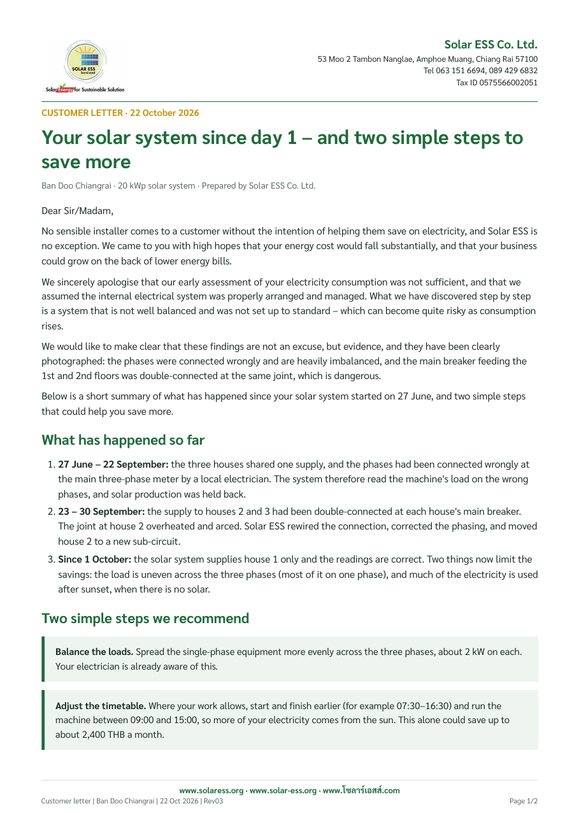
First page of the customer letter

Customer letter · 2 pages · PDF · English

Your solar system since day 1 – and two simple steps to save more

A short letter to the plant owner: what happened since commissioning, what Solar ESS has fixed, and two things the owner can do straight away.

  • The three phases of the plant's history since 27 June
  • Balance the loads at about 2 kW per phase
  • Move working hours to about 07:30–16:30 – up to about 2,400 THB saved a month
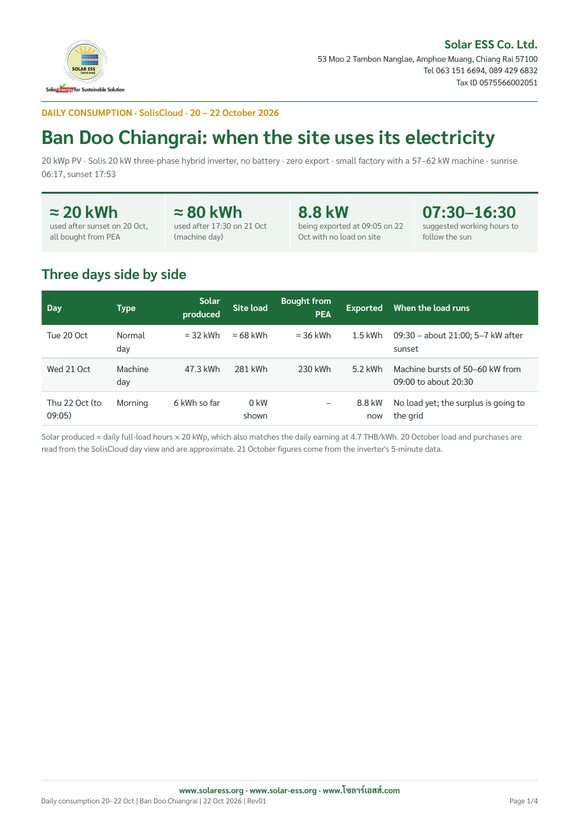
First page of the daily consumption report

Case study · 4 pages · PDF · English

When the site uses its electricity: three days of consumption at a small factory

SolisCloud day views from a 20 kWp zero-export plant in Chiang Rai show most of the load arriving after sunset while the morning sun goes unused – and why moving working hours to follow the sun would pay.

  • Normal day: about 20 kWh used after sunset
  • Machine day: 29% of the energy used after 17:30
  • 22 October morning: 8.8 kW exported with no load on site
  • Working hours of 07:30–16:30 could save up to about 2,400 THB a month
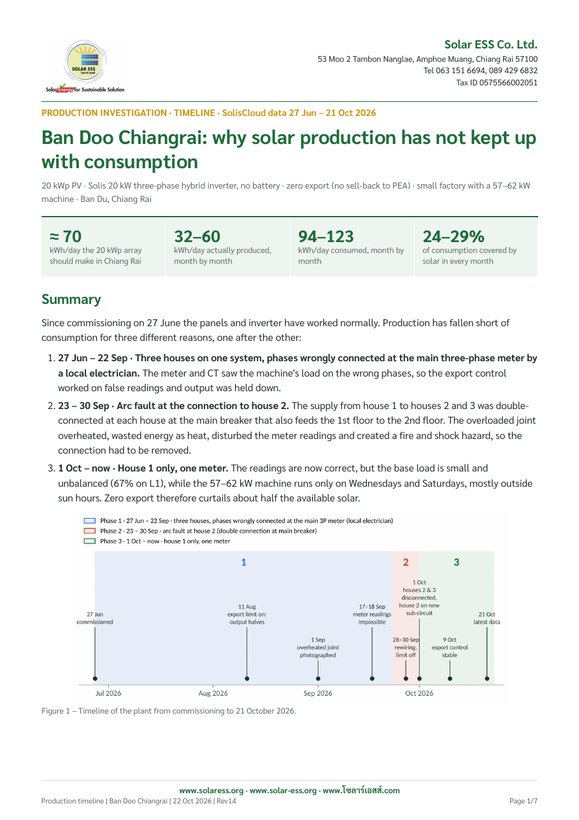
First page of the production timeline report

Case study · 14 pages · PDF · English

Why solar production has not kept up with consumption: a three-phase timeline

A 20 kWp zero-export plant at a small factory in Chiang Rai, from commissioning to today: phases wrongly connected at the main meter, an arc fault from a double connection at the main breaker, and then phase imbalance and machine days – with options for safety and lower electricity bills.

  • Timeline and monthly production and consumption
  • What held production back in each phase
  • Is the 20 kWp system the right size?
  • Options A–C: safety, using more solar, and storage – with the overheated-joints research report as an appendix
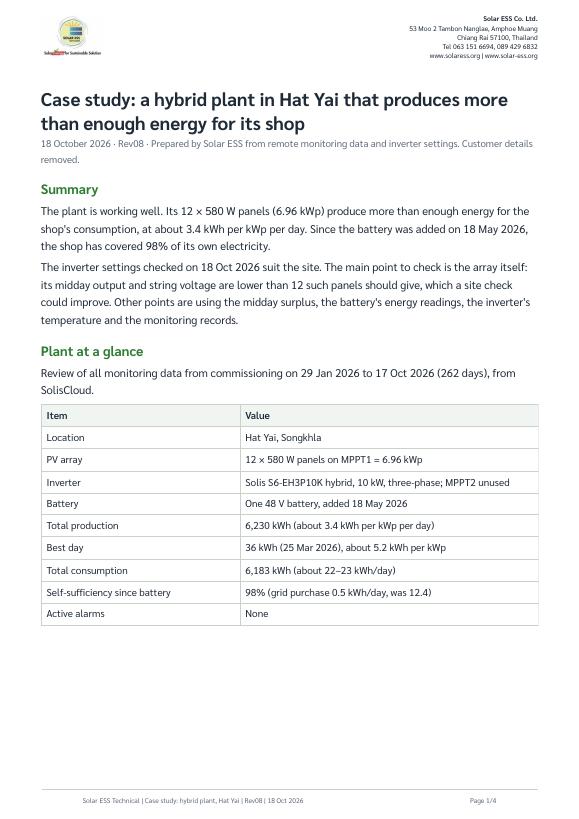
First page of the hybrid plant case study

Case study · 4 pages · PDF · English, Thai

A hybrid plant that produces more than enough energy for its shop

A remote review of a 6.96 kWp hybrid plant with battery at a small business in Hat Yai. It produces more than enough energy for the shop and covers 98% of its electricity.

  • Monthly production against a typical 6.96 kWp plant
  • Why a low string voltage points to panels not contributing fully, and how to check on site
  • Inverter settings checked: self-use mode, unbalanced output and the PEA grid code
  • Battery energy counters that do not add up, and why that matters
  • Six actions in priority order, from a site check of the array to completing the monitoring records
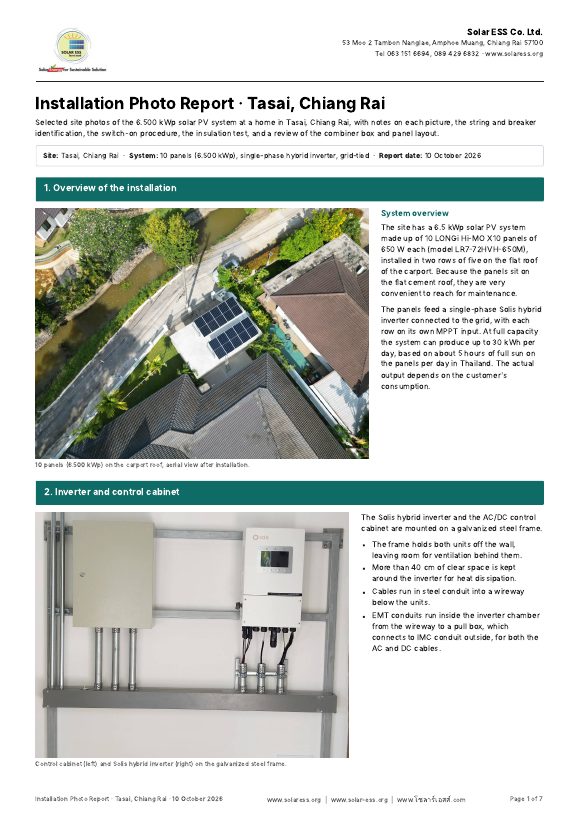
First page of the installation photo report

Installation report · 7 pages · PDF · English, Thai, Dutch, French

Installation photo report: 6.5 kWp home system in Tasai, Chiang Rai

A complete handover report for a 10-panel hybrid system, showing how we document an installation for the owner.

  • Control cabinet components, switch-on procedure and inverter indicator lights
  • String layout, panel structure drawing to scale and the circuit diagram, DC and AC
  • Insulation test, thermal check of every connection and the tools used
  • Full list of materials with brands and ratings
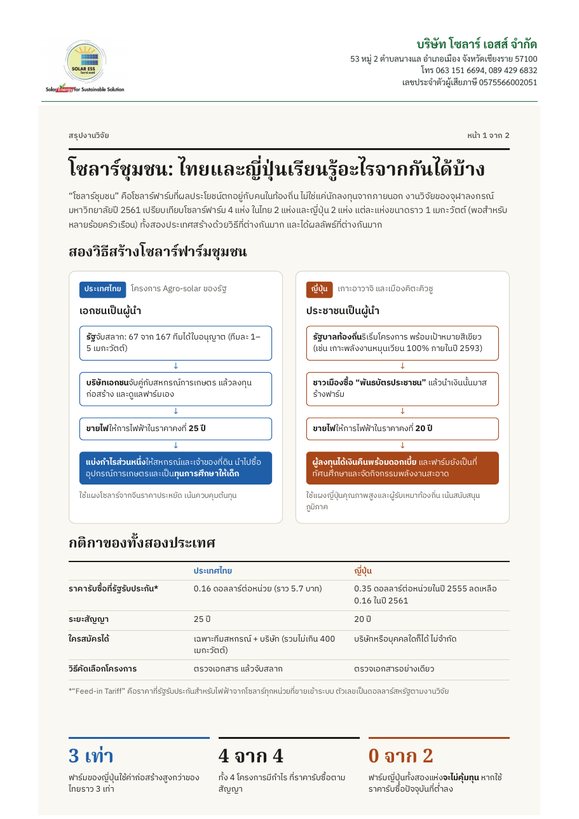
หน้าแรกของสรุปงานวิจัยโซลาร์ชุมชน

สรุปงานวิจัย · 2 หน้า · PDF · ภาษาไทย

โซลาร์ชุมชน: ไทยและญี่ปุ่นเรียนรู้อะไรจากกันได้บ้าง

สรุปงานวิจัยของจุฬาลงกรณ์มหาวิทยาลัย ปี 2561 ที่เปรียบเทียบโซลาร์ฟาร์มชุมชนขนาดประมาณ 1 เมกะวัตต์ สี่แห่งในไทยและญี่ปุ่น

  • รูปแบบที่ภาคธุรกิจนำของไทย และรูปแบบที่ประชาชนนำของญี่ปุ่น
  • ต้นทุน ผลตอบแทน และการยอมรับของคนในพื้นที่
  • โซลาร์ชุมชนที่ดีควรผสมจุดแข็งของทั้งสองแบบ

A question about your own site?

Tell us what you are building and we will answer with a preliminary design.

Book a consultation
LINEFacebookCall us